Mostrando entradas con la etiqueta Chemical. Mostrar todas las entradas

viernes, 4 de octubre de 2013

El ataque químico en Damasco fue perpetrado por mercenarios de Arabia Saudita

El ataque químico en el suburbio de Damasco fue realizado por un grupo de mercenarios de Arabia Saudita para desestabilizar la situación, informa la agencia Interfax citando a fuentes diplomáticas rusas.

Al analizar los datos de una serie de fuentes podemos sacar la conclusión de que "la provocación criminal en Guta Oriental fue efectuada por un grupo de mercenarios enviados por los sauditas a través de Jordania, que actuaba con el apoyo del grupo Liwa Al-Islam", dijo a Interfax una de las fuentes.

El ataque y sus consecuencias tuvieron un gran impacto en la sociedad siria, señaló otra fuente.

"Sirios de diferentes opiniones políticas, entre ellos algunos combatientes de la oposición, están tratando de informar a los diplomáticos y miembros de organizaciones internacionales que trabajan en Siria lo que saben del crimen y las fuerzas que lo inspiraron", agregó.

El pasado 19 de marzo al menos 25 personas murieron en la provincia de Alepo por un ataque con armas químicas. Para investigar aquel trágico episodio de la guerra en Siria al país llegó un grupo de expertos de la ONU. Poco después de su llegada, el 21 de agosto, se produjo otro ataque químico en las afueras de Damasco que motivó los posteriores planes de una intervención militar de EE.UU. y sus aliados.

La semana pasada los países miembros del Consejo de Seguridad de la ONU aprobaron por unanimidad la resolución, acordada por Rusia y Estados Unidos, para eliminar las armas químicas en Siria. El canciller ruso, Serguéi Lavrov, declaró que la resolución elimina por completo el uso de la fuerza.

Texto completo en: http://actualidad.rt.com/actualidad/view/107507-arabia-saudita-armas-quimicas-siria

jueves, 12 de septiembre de 2013

Pro-Syrian opposition ‘analyst’ fired for lying about credentials. WND: U.S. MILITARY CONFIRMS REBELS HAD SARIN. US, al-Qaeda: From enemies to allies


Section : Politics - Syria

Breaking News Network - Agencies

A Washington scholar whose writings on Syria were touted by top U.S. officials in making the case for a military strike has been fired from the Institute for the Study of War for allegedly lying about her education credentials.

The development comes after Elizabeth O'Bagy's credibility and objectivity had come under scrutiny over her work with a Syrian opposition advocacy group.

The institute, where she had worked as a senior analyst, on Wednesday posted a terse statement on its website claiming she also misled the organization about having a Ph.D.

"The Institute for the Study of War has learned and confirmed that, contrary to her representations, Ms. Elizabeth O'Bagy does not in fact have a Ph.D. degree from Georgetown University. ISW has accordingly terminated Ms. O'Bagy's employment, effective immediately," the statement said.

. O'Bagy said she had defended her dissertation at Georgetown, but was still waiting for the university to confer the degree.

A spokesman for Georgetown tells said that all they could confirm was O'Bagy had received her undergraduate degree and master's degree there, but she was not currently registered.

“Georgetown University confirms that Elizabeth O'Bagy received a Bachelor of Arts degree in 2009 and a Master of Arts degree in 2013," Rob Mathis of Georgetown's Office of Communications said. "At this time she is not a registered student.”

Georgetown records also show O'Bagy also studied abroad through American University in Cairo.

During discussions about military action in Syria last month, O'Bagy wrote an influential piece in The Wall Street Journal that was used to push for punishing the Syrian regime for using chemical weapons.

The Aug. 30 piece disputed claims that the opposition is heavily populated by extremist factions. "Contrary to many media accounts, the war in Syria is not being waged entirely, or even predominantly, by dangerous Islamists and al Qaeda die-hards," she wrote, while calling for a "comprehensive strategy" to destroy Syrian military capability and boost the opposition.

Both Sen. John McCain, R-Ariz., and Secretary of State John Kerry cited her article during congressional hearings. McCain read from the piece, describing it as an "important op-ed by Dr. Elizabeth O'Bagy." Kerry cited it the next day while appearing before a House committee, urging lawmakers to read it.

But questions were soon raised about O'Bagy's connection with a group called the Syrian Emergency Task Force. The Journal, after the op-ed was first published, included a clarification noting she is "affiliated" with that group, and that the organization subcontracts with the U.S. and British governments "to provide aid to the Syrian opposition."

O'Bagy also appeared several times to discuss Syria on Fox News, CNN, NPR and other media outlets.

O'Bagy, in an interview last week on Fox News, claimed she is not an employee of the task force, and is not a lobbyist. She said she works with them as an independent contractor, and her contract fee comes through U.S. government contracts.

She also defended herself on Twitter, claiming she is "not paid to advocate" the view that the U.S. should get involved in Syria.

"I have never tried to hide my affiliate with the Syrian Emergency Task Force," she wrote, claiming she works not as a lobbyist but a research consultant on "humanitarian aid & civil governance contracts."

Indeed, an article she co-wrote on Syria that was published by The Atlantic in June did include a line acknowledging her ties with the Syrian Emergency Task Force.

Her Twitter page, though, identifies her only as "Syria Analyst at the Institute for the Study of War."

Work for the task force also was omitted from the bio that previously appeared on the website for the Institute for the Study of War. O'Bagy was listed as having issued "major reports" on the Syrian opposition. The bio said she "traveled extensively to the region to gain perspective on the situation."

The bio said she had received her Master's and Ph.D. in Arab Studies and Political Science at Georgetown. It said she also had a bachelor's in Arabic and Arab Studies from the same university.

http://breakingnews.sy/en/article/25277.html

WND: U.S. MILITARY CONFIRMS REBELS HAD SARIN

Section : Politics - Syria

Breaking News Network - Newspapers

WND, an online US newspaper says that classified documents shows deadly weapon found in home of arrested Islamists.

The newspaper argues that evidences indicate that opposition fighters were responsible for the chemical gas attack. The newspaper supports its claims with accounts taken from parts of Obama administration saying that the chemical weapons were used by “rebels,” not by the Syrian government.

The newspaper also talks about the site of the “kitchen” were the chemicals had been “cooked”.

The newspaper’s article goes:

As part of the Obama administration’s repeated insistence – though without offering proof – that the recent sarin gas attack near Damascus was the work of the Syrian regime, the administration has downplayed or denied the possibility that al-Qaida-linked Syrian rebels could produce deadly chemical weapons.

However, in a classified document just obtained by WND, the U.S. military confirms that sarin was confiscated earlier this year from members of the Jabhat al-Nusra Front, the most influential of the extremist rebel groups fighting in Syria.

The document says sarin from al-Qaida in Iraq made its way into Turkey and that while some was seized, more could have been used in an attack last March on civilians and Syrian military soldiers in Aleppo.

The document, classified Secret/Noforn – “Not for foreign distribution” – came from the U.S. intelligence community’s National Ground Intelligence Center, or NGIC, and was made available to WND Tuesday.

It revealed that AQI had produced a “bench-scale” form of sarin in Iraq and then transferred it to Turkey.

A U.S. military source said there were a number of interrogations as well as some clan reports as part of what the document said were “50 general indicators to monitor progress and characterize the state of the ANF/AQI-associated Sarin chemical warfare agent developing effort.”

“This (document) depicts our assessment of the status of effort at its peak – primarily research and procurement activities – when disrupted in late May 2013 with the arrest of several key individuals in Iraq and Turkey,” the document said.

“Future reporting of indicators not previously observed would suggest that the effort continues to advance despite the arrests,” the NGIC document said.

The May 2013 seizure occurred when Turkish security forces discovered a two-kilogram cylinder with sarin gas while searching homes of Syrian militants from the al-Qaida-linked Jabhat al-Nusra Front following their initial detention.

The sarin gas was found in the homes of suspected Syrian Islamic radicals detained in the southern provinces of Adana and Mersia.

Some 12 suspected members of the al-Nusra Front were arrested. At the time, they were described by Turkish special anti-terror forces as the “most aggressive and successful arm” of the Syrian rebels.

In the seizure, Turkish anti-terror police also found a cache of weapons, documents and digital data.

At the time of the arrest, the Russians called for a thorough investigation of the detained Syrian militants found in possession of sarin gas.

This seizure followed a chemical weapons attack in March on the Khan al-Assal area of rural Aleppo, Syria. In that attack, some 26 people and Syrian government forces were killed by what was determined to be sarin gas, delivered by a rocket attack.

The Syrian government called for an investigation by the United Nations. Damascus claimed al-Qaida fighters were behind the attack, also alleging that Turkey was involved.

“The rocket came from a place controlled by the terrorists and which is located close to the Turkish territory,” according to a statement from Damascus. “One can assume that the weapon came from Turkey.”

The report of the U.S. intelligence community’s NGIC reinforces a preliminary U.N. investigation of the attack in Aleppo which said the evidence pointed to Syrian rebels.

It also appears to bolster allegations in a 100-page report on an investigation turned over to the U.N. by Russia. The report concluded the Syrian rebels – not the Syrian government – had used the nerve agent sarin in the March chemical weapons attack in Aleppo.

While the contents of the report have yet to be released, sources tell WND the documentation indicates that deadly sarin poison gas was manufactured in specific area in Iraq and then transported to Turkey for use by the Syrian opposition, whose ranks have swelled with members of al-Qaida and affiliated groups.

The documentation that the U.N. received from the Russians indicated specifically that the sarin gas was supplied to foreign fighters by a Saddam-era general.

The sarin nerve gas used in the Allepo attack, sources say, had been prepared by former Iraqi Military Industries Brigadier. It then was supplied to al-Nusra Front in Aleppo, with Turkey’s cooperation, through the Turkish town of Antakya in Hatay Province.

The source who brought out the documentation now in the hands of the U.N. is said to have been an aide to the Iraqi brigadier.

The NGIC depiction of the variety of sarin as “bench-scale” reinforces an analysis by terrorism expert Yossef Bodansky, who said the recent findings on the chemical weapons attack of Aug. 21 on the outskirts of Damascus, Syria, was “indeed a self-inflicted attack” by the Syrian opposition to provoke U.S. and military intervention in Syria.

Bodansky, a former director of the U.S. Congressional Task Force on Terrorism and Unconventional Warfare, said a preliminary analysis of the sarin showed that it was of a “kitchen” variety and not military grade.

He questioned that the sarin was of a military variety, which accumulates around victims’ hair and loose clothing.

Because these molecules become detached and released with any movement, Bodansky said, “they would have thus killed or injured the first responders who touched the victims’ bodies without protective clothes … and masks.”

Various videos of the incident clearly show first responders going from patient to patient without protective clothing administering first aid to the victims. There were no reports of casualties among the first responders.

“This strongly indicates that the agent in question was the slow acting ‘kitchen sarin,’” Bodansky said.

“Indeed, other descriptions of injuries treated by MSF (The French group Doctors Without Borders) – suffocation, foaming, vomiting and diarrhea – agree with the effects of diluted, late-action drops of liquefied Sarin,” he said.

The terrorism expert said that the jihadist movement has technologies which have been confirmed in captured jihadist labs in both Turkey and Iraq, as well as from the wealth of data recovered from al-Qaida in Afghanistan in 2001 and 2002.

He added that the projectiles shown by the opposition, which were tested by U.N. inspectors, are not standard weapons of the Syrian army.

Meanwhile, an Italian former journalist and a Belgian researcher who were recently freed from their al-Nusra captives say they overheard their captors talking about their involvement in a deadly chemical attack “last month,” which would have been the Aug. 21 chemical weapons attack.

The Italian, Domenico Quirico, and Belgian researcher Pierre Piccinin were released Monday after five months of captivity.

“The government of Bashar al-Assad did not use Sarin gas or other types of gas in the outskirts of Damascus,” Piccinin said.

While captive, Piccinin said the two had overheard a Skype conversation in English among three people.

“The conversation was based on real facts,” said Quirico, claiming one of the three people in the alleged conversation identified himself as a Free Syrian Army general.

He added that the militants said the rebels carried out the attack as a provocation to force the West to intervene militarily to oust the Syrian regime.

Both men told a news conference they had no access to the outside world while they were held captive and knew nothing about the use of chemical weapons until they heard the discussion on Skype.

Now, a former analyst for the Central Intelligence Agency, Ray McGovern, similarly backs the claim that the Syrian rebels perpetrated the poison gas attack on Aug. 21

McGovern was one of a number of veteran intelligence professionals who recently signed a letter to Obama saying that Damascus wasn’t behind the Aug. 21 chemical attack.

As WND recently reported, former U.S. intelligence analysts claim current intelligence analysts have told them the Syrian government was not responsible for the Aug. 21 poison gas attack, saying there was a “growing body of evidence” that reveals the incident was a pre-planned provocation by the Syrian opposition.

The analysts, in an open letter to Obama, referred to a meeting a week before the Aug. 21 incident in which opposition military commanders ordered preparations for an “imminent escalation” due to a “war-changing development” that would be followed by the U.S.-led bombing of Syria. They said the growing body of evidence came mostly from sources affiliated with the Syrian opposition and its supporters.

Those reports, they said, revealed that canisters containing chemical agents were brought into a suburb of Damascus, where they were then opened.

“Initial meetings between senior opposition military commanders and Qatari, Turkish and U.S. intelligence officials took place at the converted Turkish military garrison in Antakya, Hatay Province, now used as the command center and headquarters of the Free Syrian Army and their foreign sponsors,” the analysts said.

The VIPS memo to Obama reinforces separate videos, which show foreign fighters associated with the Syrian opposition firing artillery canisters of poison gas. One video shows Nadee Baloosh, a member of an al-Qaida-affiliated group Rioyadh al-Abdeen, admitting to the use of chemical weapons.

In the video clip, al-Abdeen, who is in the Latakia area of Syria, said his forces used “chemicals which produce lethal and deadly gases that I possess.

http://breakingnews.sy/en/article/25276.html

A Syrian opponent uncovers documents prove the relation between US and al-Nusra Front.

Breaking News Network- Agencies

The head of the “Opposition Coordination Committee” in the Haitham Manaa has revealed that he has evidences, which prove the relation between US administration and the armed men of “Ahrar al-Sham” and al-Nusra Front.”

Manaa said in a declaration to RT that “the mediator between the Syrian community and the White House is a group of people who have mortgaged themselves to the West not to serve the democratic transition in Syria.

He adds that the situation in Syria is complicated and what worsen it is the lack of resolution of the U.S. administration because of the local and regional alliances.
US, al-Qaeda: From enemies to allies


Breaking News - Agencies

Since the beginning of the Syrian crisis in 2011, reports have been repeatedly published about the presence of al-Qaeda groups such as al-Nusra Front and other Takfiri groups in the Arab country.

Two years after the beginning of the crisis in Syria, Americans and people of other nationalities face an important question; what is the difference between the al-Qaeda of 2001 and that of 2011? Why did the US form a coalition against al-Qaeda in 2001 and why is it now trying to form a coalition to help al-Qaeda?

What is the reason for the paradox in US policies with regards to al-Qaeda and how much truth is there to what Western media says about the nature of al-Qaeda? Why did al-Qaeda end up in Syria and what is it looking for? These are questions which require answers because of the possibility of a military attack against the country as well the escalation in anti-Syria war rhetoric.

In 2001 the US announced al-Qaeda as the perpetrator of the September 11 terrorist attack in New York City. In the next step al-Qaeda became known as the symbol of terrorism and Washington’s plan for the so-called war on terror was ready for implementation. At the time many world countries and even the UN agreed the terrorism must be eradicated.

To answer this question one must first take a look at the formation of this group and its supporters. Al-Qaeda is a group which was formed in the 4th decade of the twentieth century with the financial support of Saudi Arabia and Qatar, and the military support of the US to block the influence of Soviet Russia and in a bid to control communism.

The group continued its existence until the disintegration of the Soviet Russia. According to Zbigniew Brzezinski, al-Qaeda is the child of a mutual effort by the CIA and the KSA intelligence agency in the 1980s.

Following the disintegration of soviet Russia, the rise to power of Taliban in Afghanistan and the radical behavior of this group toward the followers of other religions, public opinion was provoked.

US officials had a few meetings with al-Qaeda leaders, including Osama Bin Laden, in order to bring the group under their control, but the meetings were mostly unsuccessful as the group was uncontrollable due to having lots of wealth and weapons. The September 11 scenario was the only way that the US could control this group.

The US seemed damaged at the time and a group called al-Qaeda had attacked the country. The situation at the time prepared the ground for forming a coalition against the al-Qaeda and ultimately the US attacked Afghanistan.

Iraq was also targeted for financially supporting the al-Qaeda and having weapons of mass destruction. But to balance the power between Shias and Sunnis in Iraq the group commits its atrocities and murders under the name of the Islamic State of Iraq.

The continuation of violence in Iraq is a scenario designed by the US to counter the increasing power of Shia Muslims and the tool to carry out this is al-Qaeda affiliated groups in the country, although they pretend to disavow the US.

In 2011, dissatisfaction became evident among some Syrian Sunni communities in Aleppo and Homs and after some Syrian army officer’s treated some Sunni sheikhs US attention was drawn to Syria.

The US is currently in a position in which it can use provoking Syrians to overthrow Bashar Assad’s unfriendly government. But opposition in Syria is for a small part of the society and very soon the US realizes it cannot overthrow Bashar from inside Syria.

From May 2011 when Takfiri groups linked to al-Qaeda began entering Syria in groups or individually from the Turkish, Jordanian and Israeli borders. These individuals formed militant groups. Two of these groups including the Al-Nusra Front officially announced their affiliation to al-Qaeda. Despite this, US media and the media belonging to US allies try to portray these individuals as a part of the Syrian nation rebelling against the central government. However, gradually, reports by research institutions belonging to these countries began to emerge, showing that the majority of militants in Syria are foreign nationals.

The foreign-backed militants affiliated to al-Qaeda in Syria carry out all sorts of terrorist acts including massacring children, women, and mutilating corpses. But it appears that this time not only the international community has become deaf and blind but the US seeks also to form a coalition to assist terrorism.

This is while certain militant commanders in Syria are Turkish and Jordanian officers and some terrorists have been trained by the US in Jordan. KSA and Qatar continue to financially support militants and aid has been sent by Israel for these militants as well. In reality, the US for various reasons has decided to overthrow the Syrian government at any cost even at the cost of its credibility.

It now appears that one can understand the scenarios about Osama bin Laden’s killing. Bin Laden, the leader of al-Qaeda, has been killed and his followers are being persecuted in Yemen and Mali. But now, the ‘good’ al-Qaeda has been formed in line with US colonialist objectives. The US is even willing to support this “good al-Qaeda” at the expense of the credibility of the UN and UNSC and even its own Congress.

Currently it is not important for the US that militants are destroying churches and monasteries in Syria and setting fire to Christian homes and executing them. For them, at present, the fall of Bashar is more important than everything else.

Therefore, one can say that like the CIA, al-Qaeda is one of the US tools used to execute its demands across the world.

Whenever the White House wants, this group emerges in a country and Western governments under the pretext of supporting that country in countering al-Qaeda (like what happened in Afghanistan and Mali) or under the pretext of supporting al-Qaeda against the central government (like what’s happening in Syria at present), meddle in that country.

What is most important and should be taken into consideration is the level of consciousness of the international community about the US manipulation. It appears that this time the people of the world have not believed US claims about Syria, but also at a higher level, US Congressmen are also looking at the matter with doubt.
http://breakingnews.sy/en/article/25235.html

________________________________

Elizabeth O'Bagy: On the Front Lines of Syria's Civil War


NOTE:
I heard this woman interviewed on NPR just a couple of days ago.
I just KNEW she was lying and full of digested canine dog food, the authenticity of her alleged 'expertise' came off as that of an eight year old pontificating on the historical significance of the SALT talks

“I will bring just one Sarin…Sarin gas,” says FSA jihadist rebel


In this video, two Syrian (Muslim Brotherhood/al-Qaeda linked) rebels can be heard coordinating a Sarin gas attack on a nearby building. As smoke billows a short distance from the building, a rebel on the ground can be heard directing someone – presumably at launch site to change his direction.

Shoebat Recent news of a chemical weapons attack in Syria smacks of desperation. The question comes down to who is most desperate right now, the Assad regime or the Muslim Brotherhood rebels? Consider that since June, Assad’s forces have been winning. According to a CBS News report from last month, victories for the rebels had become “increasingly rare” and that the Muslim Brotherhood-backed opposition fighters were sustaining “some of their heaviest losses” near Damascus.


FSA rebel jihadists loading what appears to be a chemical weapon
Even before Assad’s forces gained winning momentum, a UN official reportedly found evidence of rebels using chemical weapons but no evidence Assad’s regime did. This, from a Washington Times article by Shaun Waterman dated May 6, 2013:


Testimony from victims strongly suggests it was the rebels, not the Syrian government, that used Sarin nerve gas during a recent incident in the revolution-wracked nation, a senior U.N. diplomat said Monday.

Carla del Ponte, a member of the U.N. Independent International Commission of Inquiry on Syria, told Swiss TV there were “strong, concrete suspicions but not yet incontrovertible proof,” that rebels seeking to oust Syrian strongman Bashar al-Assad had used the nerve agent.

But she said her panel had not yet seen any evidence of Syrian government forces using chemical weapons, according to the BBC, but she added that more investigation was needed
The Syrian army discovered a storehouse belonging to rebels in the Damascus area of Jobar, where toxic chemical substances, including chlorine, have been produced and kept.


It’s significant to consider that the rebels were reportedly using chemical weapons at a time when Assad was more desperate than he is now. Again, why would Assad use chemical weapons now and not then? Who is more desperate at this point in the conflict? The answer is, the Muslim Brotherhood rebels, who have no problem killing themselves (or their own) if the cause of Islam is moved forward.
In June, testimony from a UN Panel implicated Syrian Rebels, NOT the Assad regime, for staging chemical weapons attacks, using Sarin gas.

UN Panel implicates Syrian Rebels in Chemical weapons attacks


martes, 3 de septiembre de 2013

U.S. intelligence agencies involved in chemical attack in Syria. Hacker got access to U.S. intelligence correspondence and published U.S. Army Col. ANTHONY J. MACDONALD’s mail. Macdonald is General Staff Director, Operations and Plans Office of the Deputy Chief of Staff for Intelligence the Army Staff. It’s about chemical attack in Syria.


By debatableopinion


The situation in Syria is still in the focus of world media. Experts predict another U.S. aggression for “human rights”. Washington regularly declares its readiness to attack Syria. The official version – to punish al-Assad and Syrian army for the use of chemical weapons against the civilian population.

Meanwhile, the media has spread new proofs of the U.S. intelligence involvement to chemical attack near Damascus. Hacker got access to U.S. intelligence correspondence and published U.S. Army Col. ANTHONY J. MACDONALD’s mail. Macdonald is General Staff Director, Operations and Plans Office of the Deputy Chief of Staff for Intelligence the Army Staff. It’s about chemical attack in Syria.

In the message August 22 Eugene Furst congratulates Col. on successful operation and refers him to Wasington Post publication about chemical attack in Syria. From the Anthony’s wife dialog with her friend it’s clear the video with the children killed in the chemical attack near Damascus was staged by U.S. Intelligence.

Published data indicate Washington is willing to do anything to achieve its goals in the Middle East. Support for the Syrian opposition with political means and weapons hasn’t brought the expected results.

Under the circumstances the U.S. is ready once again to violate international law and attack Syria without UN Security Council approval. The world’s still the same – if policy doesn’t work, the aircraft carriers start acting!

http://pastebin.com/zeXpsRnh


MORE:
I also hacked other Pentagon officers' mail boxes:

Evans, Anthony O COL USARMY HQDA ASA ALT  (US)
Sims, John D COL USARMY HQDA OCPA (US)
Griffith, David M COL USARMY (US)
Bell, Craig A COL USARMY (US)
Parramore, David J (Dave) COL USARMY  MEDCOM HQ (US)
Morris, Daniel L COL USARMY (US)
Ellison, Brenda K COL USARMY (US)
Jennings, Wesley J COL USARMY HQDA DCS G-8  (US)
Eberle, Brian K COL  USARMY HQDA DCS G-3-5-7 (US)
Bradsher, John M COL USARMY (US)
Fish, Charles A COL USARMY JS J8 (US)
Roquemore, Darlene M COL USAF (US)
Mott, Robert L Jr COL USARMY HQDA  OTSG (US)
Parramore, David J (Dave) COL USARMY  MEDCOM HQ (US)
Weeks, Colin A LTC USARMY (US)
Reynolds, M Bridget LTC USARMY HQDA DCS G-2 (US)
Grahek, Christopher J LTC USARMY HQDA  OTSG (US)
Henderson, Valerie D LTC USARMY HQDA OCPA (US) 

I've no time to look through all their mails. A lot of shit to be sure there. 
I will upload their correspondence later. 

domingo, 16 de junio de 2013

Chemical Weapons; Jabhat al-Nusra; The End Game; Recognizing National Coalition

A number of journalists have asked me if I believe Assad is likely to use chemical weapons. Here is the way I think about it:
Assad is unlikely to use chemical weapons at this time. He must know that as soon as he uses them, he will have written his death warrant. I do not think he is suicidal or about to pursue a “Samson option” as some have suggested.
The Alawite community of 2.5 million that lives in the coastal region of Syria is counting on his army to protect them from possible retribution from the rebel militias. Sectarian hatred has been driven to a high pitch by the brutality of the regime. Syrians have been putting hate in their hearts over the last two years, making the likelihood of some sort of retribution ever more likely and the ethnic cleansing a possibility, even if a small one at this time. Assad and his generals will want to protect their families who live along the Mediterranean coast.
Should Damascus become ungovernable, as I believe it eventually will — although that may be a long time from now — he will have to fall back with his army to the coastal region. Then he will have his back to the wall and the likelihood of his using chemical weapons goes way up. He would most likely threaten to use them should rebel militias begin pushing into the Alawite Mountains or attack the coastal cities. He will want to keep them as a deterrent.
The Chemical weapons scare now going on may be overblown. Speaking to a general at Central Command in Tampa yesterday, I was reminded that chemical weapons are difficult to arm and use. Sarin was used by Saddam in Halabcha, where bombs were dropped by planes, which means that Assad could do the same because he has an airforce. But for the rebels to use them effectively would be difficult, without proper missiles or systems to launch projectiles which are difficult to arm.
Here is a section from Tony Karon’s most recent Time article, which is excellent as always. It reflects my understanding of what the regime’s thinking may become:
Yet, such a fracturing of Syria could, in the minds of some of the hard men around Assad, offer the prospect of salvaging more than they might if the regime is defeated and replaced by a strong, Sunni-dominated central state.  Assad’s regime is not so much a personality-cult dictatorship as it is a system of Alawite minority rule and privilege, and its core remains a cohesive, heavily armed and highly motivated Alawite-dominated army that believes it is fighting for the survival of its community. Even once it recognizes that it can no longer rule the entire country, its sectarian communal logic may militate against making a desperate last stand in Damascus, a predominantly Sunni city.
“Nobody knows what they’re thinking in the regime’s inner circles, but to the extent that the regime is making rational decisions, it doesn’t make much sense to take the ‘Samson option’ and use chemical weapons,” says University of Oklahoma Syria scholar Joshua Landis, referring to the Biblical figure who wanted to take down all with him as he died fighting. ”Unlike Gaddafi in Libya, Assad is ruling on behalf of a community, and the key decisions may not be his alone to make. The Alawite strongmen around him don’t want to commit suicide. They want to protect themselves and their families from the violent retribution they fear is inevitable if the regime falls.” That, argues Landis, may make them more likely to favor a retreat to the Alawite heartland along the coast, where they’ll have a greater base of strength than they do in Damascus. If so, the regime, as we know it, will have fallen, but the civil war would be far from over.
If the Assad regime’s Alawite security core, which could field significantly more than 50,000 men motivated by fear for their lives, was to abandon Damascus, its best hope would lie in Syria breaking up into warring fiefdoms rather than reconstituting as a strong Sunni-dominated central government. The regime’s earlier strategic decision to cede control of Kurdish areas to a separatist militia with no intention of bowing to any authority in Damascus appears to reflect a preference for Balkanizing those parts of Syria it can no longer control. The regime will therefore also hope to see its enemies divided by the schism in rebel ranks between more extreme Salafist groups and those deemed secular or more moderately Islamist. Right now, the Syrian opposition coalition recently formed in Doha, Qatar, at Western behest may be recognized by France, Britain and Gulf states as the “sole legitimate representative of the Syrian people,” but its control over fighting units on the ground remains an aspiration rather than an established fact.
Some of the most striking recent rebel victories in overrunning Assad’s bases have been chalked up by the Qaeda-inspired Jabhat al-Nusra militia, whose numbers are reportedly swelling to the point that its rivals estimate it fields up to 10,000 men, many of whom play the leading combat role on the fronts where they’re deployed.
Jabhat al-Nusra
The announcement by US officials that they are moving to proscribe Jabhat al-Nusra as a terrorist organization at this time is a bit confusing. It sends controdictory messages. Whose side is Washington on? Does it want to bring down Assad and support the rebels? Or does it want to start a civil war among the rebels? The latter would would be a boon to the Assad regime.
It sends a message to Qatar and Saudis: “don’t send money to Salafi groups or we will nail you for aiding terrorists and freeze any assets you have in the West.” It would also allow Congress to begin setting policy buy setting sanctions against any militia or regional authority that associates with Jabhat al-Nusra. The Treasury Department’s expanding anti-terrorism branch will also begin to set policy, as it must enforce this sanction.
Here is an NPR clip I did about this yesterday: Syrian Militia Leaders Depend On A Terrorist Faction – “Melissa Block talks with Joshua Landis about the ongoing conflict in Syria and whether the Bashar al-Assad regime has reached a tipping point.”
But it remains to be seen how a U.S.-authored move against the Nusra Front will be received by fighting units to whom the jihadists have become valuable partners in combat, while the U.S. is widely viewed by rebel fighters as having done little for their cause.
Still, the Lebanese paper As-Safir reported Tuesday:
Many expect a fierce battle to break out between the Salafists and the al-Nusra Front on one hand and the other armed groups on the other, under the pretext of uniting the [Free Syrian Army]… The FSA cannot unite without settling the Salafist and jihadist issue once and for all. That may happen if the West puts this as condition for sending arms, some believe.
Civil wars, within civil wars, along the lines of those fought in Lebanon between 1976 and 1992 may be viewed as the best hope of survival by the hard men of the regime who turned Syria’s rebellion into a bloody sectarian war almost two years ago. That war has steadily dismembered the Syrian state; rebuilding it on new terms could take many turbulent years. At least, that’s what the more far-sighted in Assad’s circles may be hoping.
It’s Time to Recognize the Opposition in Syria – Room for Debate  – New York times
“As Good as It’s Going to Get” by Joshua Landis, December 5, 2012
Washington should recognize and support the newly formed National Coalition of Syrian Revolutionary and Opposition Forces. The United States has spent the last 21 months insisting on unity in what turns out to be a very fragmented Syrian opposition. This group is as good as it is going to get. It is filled with elite Syrians, who are educated, relatively pro-American, not too anti-Israel and not too Islamist — many of whom have gone to jail for their beliefs. This group will be able to retain popular backing from the West.
The problem is that events on the ground in Syria have largely overtaken this effort at statecraft. Hundreds of militias are bringing down the Assad regime. They have largely driven the Syrian military out of the north and east of the country at a tremendous cost. They tend to look at the coalition as a foreign concoction, selected by unknown hands, and representing only itself.
The Syrians fighting in the militias come from a very different background than those placed at the head of the coalition. They grew up in mostly rural areas and have only basic educations. Salafism is the ideology of the day, taking root with growing speed. Most come from the north of the country and the poorer towns outside of Aleppo, Idlib and Homs. Some have already rejected the coalition, others have said they will cooperate with it on the condition that it delivers money and arms soon, but none are likely to cede it real authority. The president and his two deputies all grew up in Damascus and hail from elite families. None have military experience.
The big question that haunts the coalition is how it will gain control of the armed elements of the revolution. Today, Syria is ruled by guns, radicals and tough guys. It will take a miracle for the U.S. to glue this new exile leadership on top of the militia lords in Syria.
From Juan Cole  – thanks Juan
The phone conversation above between two Alawite soldiers is very telling. They are caught in bases in the North that are about to fall to rebels, who presumable captured this recording and posted it to youtube. They are dispirited. Read this excellent article by Marlin Dick in the Daily Star about it.
…They both complain about the lack of support from other units, the inability to use many roads – “you just get blown up if you do” – and the isolation.
Throughout the rest of the conversation they make several brief references to the state of the war and the regime’s prospects for victory. The caller talks about being a “strike force” in the area while the second man, who is markedly demoralized, rejects the idea, based on the steady, bloody attrition.
“No … no … we’re not a strike force,” he insists, before asking: “What’s the point of being out here?”
The caller tries repeatedly to boost his friend’s morale but at one point blurts out: “There’s no solution.”
When the caller asks about defections, the demoralized officer’s response is: “No, there haven’t been any defections … there’s just … disgust.”
Neither man presumes to predict how or when the war will end. Since it is the Eid, the caller asks his friend if sweets, baklava, were offered at the base to mark the holiday.
“No, they didn’t bring me anything,” the demoralized officer responds immediately, before adding: “They brought me worries.”….As the caller laments a few times during the conversation, “There’s no one left from our graduating class.” مسرب مكالمة لضابطين من وادي الضيف وسراقب معنويات فوووق
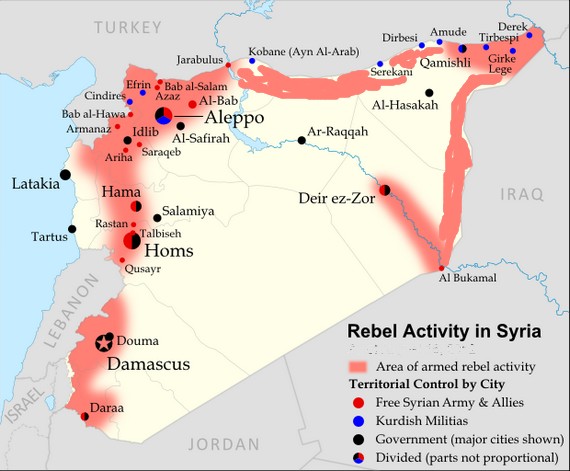
From Free Syrian Army sources it seems that FSA surrounds the city of Aleppo in a circle with wide gaps. The circle stretches 3 to 10 miles outside the city limits. The Syrian Army controls inside this big circle except the south half of the city. There is a narrow no-mans land (about 5 percent of the city area) between the two halves of the city where most of the face-to-face fighting is taking place.
Under siege by drones in Pakistan and Yemen, al Qaeda 3.0 has exploited the Arab Awakening to create its largest safe havens and operational bases in more than a decade across the Arab world. This may prove to be the most deadly al Qaeda yet. The …
The ways in which the Syrian regime has been portrayed are reminiscent of the common tendency to view violence generally as deeply irrational, and – from ill-defined but morally unwavering liberal perspectives— as always counterproductive, destructive and self-defeating. Indeed, the more violence the Syrian regime resorted to, the more it came to be portrayed as inherently inadequate and senseless. In his questioning of the irrational qualities habitually attributed to armed conflict and violence generally, one scholar, Christopher Cramer (2006), gave his book the title “civil war is not a stupid thing”. Similarly, but with far more modest objectives, I present my argument that, during the uprising in Syria, authoritarian governance and repression has not been a ‘stupid thing’ either; on the contrary, and moral considerations and judgments set aside, the Syrian regime’s responses to the uprising suggest that it is ‘in-touch’, calculative, ‘rational’, and learning –if by trial and error, and surely without necessarily quelling the uprising.  FULL TEXT AT
Bunker Mentality
2012-12-04 Telegraph View
Dec. 4 (Telegraph) — Even if President Bashar al-Assad remains rational, no one can be sure that he still controls Syria’s chemical arsenal, one of the largest in the world
With one miscalculation after another, President Bashar al-Assad has reduced Syria to a charnel house and his regime to a bloodstained gang with no aim save survival. Judging by their stark warnings, officials in Britain and America genuinely fear that he could crown his litany of crimes and misjudgments by unleashing Syria’s arsenal of chemical weapons….Mr Assad would be a latter-day Samson pulling down the pillars of
the temple
Free Syrian Army Fighters Destroy Statues of roman soldiers, calling themasnam, or idols.
The Internet – November 27, 2012
For one Syrian activist, second thoughts on the armed rebellion
By David Enders | McClatchy Newspapers, December 03, 2012
HASAKA, Syria
Hasaka is still controlled by the Syrian government, but even from the window of a taxi it’s obvious the people here have not been spared from the country’s civil war.
The lines at bakeries are daylong, and many schools are closed because they’ve become homes for refugees from other parts of the country. The power is out now as often as it is on, and fuel is in ever shorter supply.
Though she is happy to see him, Adam Ebrahem’s mother admonishes him for returning to his family’s home here.
“You shouldn’t stay,” she says. “The PYD will kill you.”
Ebrahem – it’s a pseudonym he uses for security reasons – is a 27-year-old revolutionary. A musician and a student, he was working and studying in Damascus when the rebellion against the government of President Bashar Assad began nearly two years ago. After months of demonstrating in Damascus, he returned to Hasaka to organize demonstrations. Now, as he travels across Hasaka province and in Deir al Zour province to the south, documenting the situation there, he openly wonders whether he and his fellow revolutionaries have done the right thing.
“What will we tell our children? That we started this revolution and destroyed the country?”
Ebrahem is a Kurd, the ethnic group that dominates Hasaka province and makes up about 10 percent of Syria’s population. The PYD is a Kurdish militia that is allied with the Syrian government; it’s the PYD that more or less controls the neighborhood Ebrahem’s family lives in. It also has clashed with anti-Assad rebels in northern Syria, heightening tensions between Kurds and Arabs.
The first demonstrations, particularly in Damascus, were hopeful ones and deliberate in their displays of unity among the country’s sects and ethnicities. But as the violence grew, it was the Sunni Muslim Arab population that armed itself. Though the narrative that has persisted is that arming the rebellion was the only choice, many peaceful demonstrators like Ebrahem are tepid in their support of that decision, and some oppose it outright.
Ebrahem’s family is making plans to leave Hasaka. They don’t expect it to remain free of widespread violence for much longer. No one does….
But his forebodings were right. A few days later, Ebrahem gave an update by phone.
“There was fighting between Kurdish and Arab students today at three schools in Hasaka,” he said.
He hails from a Sunni military family in a town on the outskirts of Damascus, the capital. His uncle is a serving general in President Bashar Assad’s army, several of his other relatives are also high-ranking military officers. Apart from his parents and siblings, his relatives all think he’s dead — and that’s the way he wants to keep it….
He may look calm, but he’s deeply troubled. After some nine months of fighting with several Free Syrian Army units, first on the outskirts of Aleppo and then in the city itself after the rebel push into it in late July, he has grown disillusioned with the fight and angry with its conduct. “I did this when it was clean,” he says. “Now it’s dirty. Many aren’t fighting just to get rid of Bashar, they’re fighting to gain a reputation, to build up their name. I want it to go back to the way it was, when we were fighting for God and the people, not for some commander’s reputation.”
He refused an order in November to fight a proregime, ethnic Kurdish militia in a Kurdish neighborhood of Aleppo that the rebels had entered. “Why should I fight the Kurds?” he says. “It’s a distraction. This isn’t our fight.”
Syrians in the opposition, whether armed or not, have often said that there may be a revolution after the revolution to unseat Assad. The fault lines differ depending on whom you talk to. Some envision a fight between Islamist and secular rebels; others between defectors and armed civilians; some say it will be ethnic, between Kurds and Arabs; others simply territorial, between rebel commanders in a particular area, irrespective of ideology. Others say it won’t happen. The Sniper, like many fighting men, thinks that it will, and that it will be ugly: “We will not become Somalia after Bashar falls,” he says. “We will have many Somalias in every province.”…
And so rebel snipers, especially professionally trained ones, are in great demand. The Sniper says he has “been offered so much money, it is as if I am working for the mafia.”
“Some [rebel commanders] offered me money. Others would say, ‘Just tell me what you want.’ One told me, ‘I’ll bring your parents, take them to safety. Just come and work with me,’” he says. “It does not honor me to work with people like this who think they can buy and sell me.”
Instead, he has found a home with Liwa Suqoor al-Sha‘ba, an Islamist unit of the Free Syrian Army headquartered in Azaz, a town north of Aleppo in the vast band of countryside in rebel hands around the city. For the past few months he has been stationed in the northeastern neighborhood of Bustan al-Basha, a devastated wasteland emptied of all but three of its thousands of residents. “We cannot charge on [government] positions — if we do, they will eliminate us — nor can they advance on us,” he says. “It’s not that I’m tired, but I want something new. New territory. I’m sick of it here, I’m disgusted by it.” But he respects his adversaries, who he says have pinned the rebels down now for months….
“We were in school together. We grew up together. His mother was like my mother, that’s how close we were,” he says. The Sniper is pensive, takes several deep breaths and fidgets with his 10-mm handgun as he speaks of his friend, repeatedly flicking off the gun’s safety. The young men joined the army together and stayed in contact even after the Sniper defected. He was the only person outside of the Sniper’s immediate family who knew that he was still alive. “I would tell him to defect, he’d say, ‘Not yet, it’s still early.’ I’d say defect. I told him I’d come and get him, that I would go anywhere to see him, to help him defect, even to the gates of his brigade. Whatever he wanted, wherever he was, I would get him. He kept saying, ‘It’s still early, it’s early.’ He was scared that his family would go through the same thing my family went through.” The Sniper says his family members were interrogated, harassed, ostracized in their community. The only thing that saved them from greater harm, he suspects, was the clout of the loyalist military men in his family and the fact that they thought he was dead, not a defector.
Mohammad was eventually sent to Azaz, stationed at what was called the Shatt Checkpoint. Both the Sniper and his commander repeatedly urged Mohammad to defect, warning him that they planned to attack the checkpoint. He didn’t listen. “We were three snipers. We killed a colonel, a soldier and my friend. I don’t know which one I killed, I didn’t see their faces. They were soldiers in front of us, and we were ordered to kill them.” That was three months ago.
“He’s gone anyway, what good is thinking about it? I did — for a long time afterward. I thought, ‘Why? He was my friend. Why did I shoot at him? I shouldn’t have.’ But I have left those thoughts behind me. I have to move forward.”…
“Whoever is going to be in my sights will die. That’s it,” the Sniper says. “My heart has hardened. I returned to religion, but after I killed, my heart hardened. A sniper sees who he kills,” he says, pausing. “It’s hard. A sniper sees his victim.”
Aleppo: How Syria Is Being Destroyed
The New York Review of Books 20/11/12
New York Times
Mideast’s WMD ‘red line’ gauntlet
By Bennett Ramberg, December 3, 2012, Reuters
….Remember the ultimatums that called on Iraq to get out of Kuwait in 1991; the Taliban to surrender Osama Bin Laden in 2001, and the demand Saddam Hussein leave Iraq in 2003? Each failed and war ensued.
With red line failure more often than not, both the United States and Israel must map a response. As it turns out, however, Washington may face the more immediate problem…..


______________-


Reminder: Read our article on the "chemical weapons". http://syriareport.net/chemical-weapons-evidence-comes-from-jabhat-al-nusra/


Syria Report

Read & Share Syria Report's important articles dealing with chemical weapons.

Back to Reality: Syria and Chemical Weapons: http://syriareport.net/syria-chemical-weapons/


Chemical Weapons Found in Turkey Al-Qaeda Raid: http://syriareport.net/chemical-weapons-found-in-turkey-raid/

Iraq: Al-Qaeda Chemical Weapons Plot Uncovered: http://syriareport.net/iraq-al-qaeda-chemical-weapons-plot-uncovered/

Jabhat al-Nusra Behind “Chemical Weapons” Attacks?: http://syriareport.net/chemical-weapons-evidence-comes-from-jabhat-al-nusra/


oBOMBa caught lying again. It was oBOMBa's terrorist he is arming that used the chemical weapons yet again. That make 5 times now. I bet oBOMBa and his CIA stooges are giving it to them. 
-----


FSA militants possess chemical weapons

New video footage has surfaced online showing the FSA militants (al-Qaeda, al-Nusra and friends) sponsored by Saudi and Qatar Wahhabi extremists in possession of chemical weapons. The video, which was posted on the internet recently, shows armed militants (unarmed civilians according to al-Jazeera and CNN) holding canisters containing chemical substances. The militants had earlier released footage in which rabbits were killed by inhaling poisonous gas.

It's not hard to guess the planned scenario of this modern day Goebbels's.
- First use this chemical weapons against civilians
- Then, put all the blame on the SAA
- And then, the final step, complain and cry over al-Jazeera and CNN propaganda machine about the humanitarian disaster caused by "the evil SAA"...
Read more at http://www.liveleak.com/view?i=5f6_1359454812#BwiliHjL0yfoiEb5.99

Foto: Reminder: Read our article on the "chemical weapons". http://syriareport.net/chemical-weapons-evidence-comes-from-jabhat-al-nusra/
Powered By Blogger