A number of journalists have asked me if I believe Assad is likely to use chemical weapons. Here is the way I think about it:
Assad is unlikely to use chemical weapons at this time. He must know that as soon as he uses them, he will have written his death warrant. I do not think he is suicidal or about to pursue a “Samson option” as some have suggested.
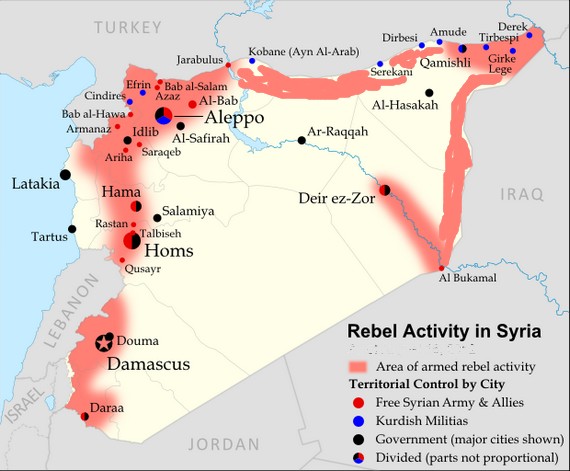
The Alawite community of 2.5 million that lives in the coastal region of Syria is counting on his army to protect them from possible retribution from the rebel militias. Sectarian hatred has been driven to a high pitch by the brutality of the regime. Syrians have been putting hate in their hearts over the last two years, making the likelihood of some sort of retribution ever more likely and the ethnic cleansing a possibility, even if a small one at this time. Assad and his generals will want to protect their families who live along the Mediterranean coast.
Should Damascus become ungovernable, as I believe it eventually will — although that may be a long time from now — he will have to fall back with his army to the coastal region. Then he will have his back to the wall and the likelihood of his using chemical weapons goes way up. He would most likely threaten to use them should rebel militias begin pushing into the Alawite Mountains or attack the coastal cities. He will want to keep them as a deterrent.
The Chemical weapons scare now going on may be overblown. Speaking to a general at Central Command in Tampa yesterday, I was reminded that chemical weapons are difficult to arm and use. Sarin was used by Saddam in Halabcha, where bombs were dropped by planes, which means that Assad could do the same because he has an airforce. But for the rebels to use them effectively would be difficult, without proper missiles or systems to launch projectiles which are difficult to arm.
Here is a section from Tony Karon’s most recent Time article, which is excellent as always. It reflects my understanding of what the regime’s thinking may become:
Yet, such a fracturing of Syria could, in the minds of some of the hard men around Assad, offer the prospect of salvaging more than they might if the regime is defeated and replaced by a strong, Sunni-dominated central state. Assad’s regime is not so much a personality-cult dictatorship as it is a system of Alawite minority rule and privilege, and its core remains a cohesive, heavily armed and highly motivated Alawite-dominated army that believes it is fighting for the survival of its community. Even once it recognizes that it can no longer rule the entire country, its sectarian communal logic may militate against making a desperate last stand in Damascus, a predominantly Sunni city.“Nobody knows what they’re thinking in the regime’s inner circles, but to the extent that the regime is making rational decisions, it doesn’t make much sense to take the ‘Samson option’ and use chemical weapons,” says University of Oklahoma Syria scholar Joshua Landis, referring to the Biblical figure who wanted to take down all with him as he died fighting. ”Unlike Gaddafi in Libya, Assad is ruling on behalf of a community, and the key decisions may not be his alone to make. The Alawite strongmen around him don’t want to commit suicide. They want to protect themselves and their families from the violent retribution they fear is inevitable if the regime falls.” That, argues Landis, may make them more likely to favor a retreat to the Alawite heartland along the coast, where they’ll have a greater base of strength than they do in Damascus. If so, the regime, as we know it, will have fallen, but the civil war would be far from over.If the Assad regime’s Alawite security core, which could field significantly more than 50,000 men motivated by fear for their lives, was to abandon Damascus, its best hope would lie in Syria breaking up into warring fiefdoms rather than reconstituting as a strong Sunni-dominated central government. The regime’s earlier strategic decision to cede control of Kurdish areas to a separatist militia with no intention of bowing to any authority in Damascus appears to reflect a preference for Balkanizing those parts of Syria it can no longer control. The regime will therefore also hope to see its enemies divided by the schism in rebel ranks between more extreme Salafist groups and those deemed secular or more moderately Islamist. Right now, the Syrian opposition coalition recently formed in Doha, Qatar, at Western behest may be recognized by France, Britain and Gulf states as the “sole legitimate representative of the Syrian people,” but its control over fighting units on the ground remains an aspiration rather than an established fact.Some of the most striking recent rebel victories in overrunning Assad’s bases have been chalked up by the Qaeda-inspired Jabhat al-Nusra militia, whose numbers are reportedly swelling to the point that its rivals estimate it fields up to 10,000 men, many of whom play the leading combat role on the fronts where they’re deployed.
Jabhat al-Nusra
The announcement by US officials that they are moving to proscribe Jabhat al-Nusra as a terrorist organization at this time is a bit confusing. It sends controdictory messages. Whose side is Washington on? Does it want to bring down Assad and support the rebels? Or does it want to start a civil war among the rebels? The latter would would be a boon to the Assad regime.
It sends a message to Qatar and Saudis: “don’t send money to Salafi groups or we will nail you for aiding terrorists and freeze any assets you have in the West.” It would also allow Congress to begin setting policy buy setting sanctions against any militia or regional authority that associates with Jabhat al-Nusra. The Treasury Department’s expanding anti-terrorism branch will also begin to set policy, as it must enforce this sanction.
Here is an NPR clip I did about this yesterday: Syrian Militia Leaders Depend On A Terrorist Faction – “Melissa Block talks with Joshua Landis about the ongoing conflict in Syria and whether the Bashar al-Assad regime has reached a tipping point.”
But it remains to be seen how a U.S.-authored move against the Nusra Front will be received by fighting units to whom the jihadists have become valuable partners in combat, while the U.S. is widely viewed by rebel fighters as having done little for their cause.Still, the Lebanese paper As-Safir reported Tuesday:Many expect a fierce battle to break out between the Salafists and the al-Nusra Front on one hand and the other armed groups on the other, under the pretext of uniting the [Free Syrian Army]… The FSA cannot unite without settling the Salafist and jihadist issue once and for all. That may happen if the West puts this as condition for sending arms, some believe.Civil wars, within civil wars, along the lines of those fought in Lebanon between 1976 and 1992 may be viewed as the best hope of survival by the hard men of the regime who turned Syria’s rebellion into a bloody sectarian war almost two years ago. That war has steadily dismembered the Syrian state; rebuilding it on new terms could take many turbulent years. At least, that’s what the more far-sighted in Assad’s circles may be hoping.
It’s Time to Recognize the Opposition in Syria – Room for Debate – New York times
“As Good as It’s Going to Get” by Joshua Landis, December 5, 2012
“As Good as It’s Going to Get” by Joshua Landis, December 5, 2012
Washington should recognize and support the newly formed National Coalition of Syrian Revolutionary and Opposition Forces. The United States has spent the last 21 months insisting on unity in what turns out to be a very fragmented Syrian opposition. This group is as good as it is going to get. It is filled with elite Syrians, who are educated, relatively pro-American, not too anti-Israel and not too Islamist — many of whom have gone to jail for their beliefs. This group will be able to retain popular backing from the West.The problem is that events on the ground in Syria have largely overtaken this effort at statecraft. Hundreds of militias are bringing down the Assad regime. They have largely driven the Syrian military out of the north and east of the country at a tremendous cost. They tend to look at the coalition as a foreign concoction, selected by unknown hands, and representing only itself.The Syrians fighting in the militias come from a very different background than those placed at the head of the coalition. They grew up in mostly rural areas and have only basic educations. Salafism is the ideology of the day, taking root with growing speed. Most come from the north of the country and the poorer towns outside of Aleppo, Idlib and Homs. Some have already rejected the coalition, others have said they will cooperate with it on the condition that it delivers money and arms soon, but none are likely to cede it real authority. The president and his two deputies all grew up in Damascus and hail from elite families. None have military experience.The big question that haunts the coalition is how it will gain control of the armed elements of the revolution. Today, Syria is ruled by guns, radicals and tough guys. It will take a miracle for the U.S. to glue this new exile leadership on top of the militia lords in Syria.

From Juan Cole – thanks Juan
The phone conversation above between two Alawite soldiers is very telling. They are caught in bases in the North that are about to fall to rebels, who presumable captured this recording and posted it to youtube. They are dispirited. Read this excellent article by Marlin Dick in the Daily Star about it.
…They both complain about the lack of support from other units, the inability to use many roads – “you just get blown up if you do” – and the isolation.Throughout the rest of the conversation they make several brief references to the state of the war and the regime’s prospects for victory. The caller talks about being a “strike force” in the area while the second man, who is markedly demoralized, rejects the idea, based on the steady, bloody attrition.“No … no … we’re not a strike force,” he insists, before asking: “What’s the point of being out here?”The caller tries repeatedly to boost his friend’s morale but at one point blurts out: “There’s no solution.”When the caller asks about defections, the demoralized officer’s response is: “No, there haven’t been any defections … there’s just … disgust.”Neither man presumes to predict how or when the war will end. Since it is the Eid, the caller asks his friend if sweets, baklava, were offered at the base to mark the holiday.“No, they didn’t bring me anything,” the demoralized officer responds immediately, before adding: “They brought me worries.”….As the caller laments a few times during the conversation, “There’s no one left from our graduating class.” مسرب مكالمة لضابطين من وادي الضيف وسراقب معنويات فوووق
Brookings: Al Qaeda 3.0: Terrorism’s Emergent New Power Bases |
2012-12-04
An American-Aleppine writes:
2012-12-04
An American-Aleppine writes:
From Free Syrian Army sources it seems that FSA surrounds the city of Aleppo in a circle with wide gaps. The circle stretches 3 to 10 miles outside the city limits. The Syrian Army controls inside this big circle except the south half of the city. There is a narrow no-mans land (about 5 percent of the city area) between the two halves of the city where most of the face-to-face fighting is taking place.
Under siege by drones in Pakistan and Yemen, al Qaeda 3.0 has exploited the Arab Awakening to create its largest safe havens and operational bases in more than a decade across the Arab world. This may prove to be the most deadly al Qaeda yet. The …
“Repression Is Not a Stupid Thing: The Syrian Regime’s Response to the Uprising,” by Reinoud Leenders (4 December 2012)
The ways in which the Syrian regime has been portrayed are reminiscent of the common tendency to view violence generally as deeply irrational, and – from ill-defined but morally unwavering liberal perspectives— as always counterproductive, destructive and self-defeating. Indeed, the more violence the Syrian regime resorted to, the more it came to be portrayed as inherently inadequate and senseless. In his questioning of the irrational qualities habitually attributed to armed conflict and violence generally, one scholar, Christopher Cramer (2006), gave his book the title “civil war is not a stupid thing”. Similarly, but with far more modest objectives, I present my argument that, during the uprising in Syria, authoritarian governance and repression has not been a ‘stupid thing’ either; on the contrary, and moral considerations and judgments set aside, the Syrian regime’s responses to the uprising suggest that it is ‘in-touch’, calculative, ‘rational’, and learning –if by trial and error, and surely without necessarily quelling the uprising. FULL TEXT AT
Bunker Mentality
2012-12-04 Telegraph View
2012-12-04 Telegraph View
Dec. 4 (Telegraph) — Even if President Bashar al-Assad remains rational, no one can be sure that he still controls Syria’s chemical arsenal, one of the largest in the world
With one miscalculation after another, President Bashar al-Assad has reduced Syria to a charnel house and his regime to a bloodstained gang with no aim save survival. Judging by their stark warnings, officials in Britain and America genuinely fear that he could crown his litany of crimes and misjudgments by unleashing Syria’s arsenal of chemical weapons….Mr Assad would be a latter-day Samson pulling down the pillars of
the temple
Free Syrian Army Fighters Destroy Statues of roman soldiers, calling themasnam, or idols.
The Internet – November 27, 2012
The Internet – November 27, 2012
For one Syrian activist, second thoughts on the armed rebellion
By David Enders | McClatchy Newspapers, December 03, 2012
HASAKA, Syria
By David Enders | McClatchy Newspapers, December 03, 2012
HASAKA, Syria
Hasaka is still controlled by the Syrian government, but even from the window of a taxi it’s obvious the people here have not been spared from the country’s civil war.The lines at bakeries are daylong, and many schools are closed because they’ve become homes for refugees from other parts of the country. The power is out now as often as it is on, and fuel is in ever shorter supply.Though she is happy to see him, Adam Ebrahem’s mother admonishes him for returning to his family’s home here.“You shouldn’t stay,” she says. “The PYD will kill you.”Ebrahem – it’s a pseudonym he uses for security reasons – is a 27-year-old revolutionary. A musician and a student, he was working and studying in Damascus when the rebellion against the government of President Bashar Assad began nearly two years ago. After months of demonstrating in Damascus, he returned to Hasaka to organize demonstrations. Now, as he travels across Hasaka province and in Deir al Zour province to the south, documenting the situation there, he openly wonders whether he and his fellow revolutionaries have done the right thing.“What will we tell our children? That we started this revolution and destroyed the country?”Ebrahem is a Kurd, the ethnic group that dominates Hasaka province and makes up about 10 percent of Syria’s population. The PYD is a Kurdish militia that is allied with the Syrian government; it’s the PYD that more or less controls the neighborhood Ebrahem’s family lives in. It also has clashed with anti-Assad rebels in northern Syria, heightening tensions between Kurds and Arabs.The first demonstrations, particularly in Damascus, were hopeful ones and deliberate in their displays of unity among the country’s sects and ethnicities. But as the violence grew, it was the Sunni Muslim Arab population that armed itself. Though the narrative that has persisted is that arming the rebellion was the only choice, many peaceful demonstrators like Ebrahem are tepid in their support of that decision, and some oppose it outright.Ebrahem’s family is making plans to leave Hasaka. They don’t expect it to remain free of widespread violence for much longer. No one does….But his forebodings were right. A few days later, Ebrahem gave an update by phone.“There was fighting between Kurdish and Arab students today at three schools in Hasaka,” he said.
The Confessions of a Sniper: A Rebel Gunman in Aleppo and His Conscience
By Rania Abouzeid / Aleppo
By Rania Abouzeid / Aleppo
He hails from a Sunni military family in a town on the outskirts of Damascus, the capital. His uncle is a serving general in President Bashar Assad’s army, several of his other relatives are also high-ranking military officers. Apart from his parents and siblings, his relatives all think he’s dead — and that’s the way he wants to keep it….He may look calm, but he’s deeply troubled. After some nine months of fighting with several Free Syrian Army units, first on the outskirts of Aleppo and then in the city itself after the rebel push into it in late July, he has grown disillusioned with the fight and angry with its conduct. “I did this when it was clean,” he says. “Now it’s dirty. Many aren’t fighting just to get rid of Bashar, they’re fighting to gain a reputation, to build up their name. I want it to go back to the way it was, when we were fighting for God and the people, not for some commander’s reputation.”He refused an order in November to fight a proregime, ethnic Kurdish militia in a Kurdish neighborhood of Aleppo that the rebels had entered. “Why should I fight the Kurds?” he says. “It’s a distraction. This isn’t our fight.”Syrians in the opposition, whether armed or not, have often said that there may be a revolution after the revolution to unseat Assad. The fault lines differ depending on whom you talk to. Some envision a fight between Islamist and secular rebels; others between defectors and armed civilians; some say it will be ethnic, between Kurds and Arabs; others simply territorial, between rebel commanders in a particular area, irrespective of ideology. Others say it won’t happen. The Sniper, like many fighting men, thinks that it will, and that it will be ugly: “We will not become Somalia after Bashar falls,” he says. “We will have many Somalias in every province.”…And so rebel snipers, especially professionally trained ones, are in great demand. The Sniper says he has “been offered so much money, it is as if I am working for the mafia.”“Some [rebel commanders] offered me money. Others would say, ‘Just tell me what you want.’ One told me, ‘I’ll bring your parents, take them to safety. Just come and work with me,’” he says. “It does not honor me to work with people like this who think they can buy and sell me.”Instead, he has found a home with Liwa Suqoor al-Sha‘ba, an Islamist unit of the Free Syrian Army headquartered in Azaz, a town north of Aleppo in the vast band of countryside in rebel hands around the city. For the past few months he has been stationed in the northeastern neighborhood of Bustan al-Basha, a devastated wasteland emptied of all but three of its thousands of residents. “We cannot charge on [government] positions — if we do, they will eliminate us — nor can they advance on us,” he says. “It’s not that I’m tired, but I want something new. New territory. I’m sick of it here, I’m disgusted by it.” But he respects his adversaries, who he says have pinned the rebels down now for months….“We were in school together. We grew up together. His mother was like my mother, that’s how close we were,” he says. The Sniper is pensive, takes several deep breaths and fidgets with his 10-mm handgun as he speaks of his friend, repeatedly flicking off the gun’s safety. The young men joined the army together and stayed in contact even after the Sniper defected. He was the only person outside of the Sniper’s immediate family who knew that he was still alive. “I would tell him to defect, he’d say, ‘Not yet, it’s still early.’ I’d say defect. I told him I’d come and get him, that I would go anywhere to see him, to help him defect, even to the gates of his brigade. Whatever he wanted, wherever he was, I would get him. He kept saying, ‘It’s still early, it’s early.’ He was scared that his family would go through the same thing my family went through.” The Sniper says his family members were interrogated, harassed, ostracized in their community. The only thing that saved them from greater harm, he suspects, was the clout of the loyalist military men in his family and the fact that they thought he was dead, not a defector.Mohammad was eventually sent to Azaz, stationed at what was called the Shatt Checkpoint. Both the Sniper and his commander repeatedly urged Mohammad to defect, warning him that they planned to attack the checkpoint. He didn’t listen. “We were three snipers. We killed a colonel, a soldier and my friend. I don’t know which one I killed, I didn’t see their faces. They were soldiers in front of us, and we were ordered to kill them.” That was three months ago.“He’s gone anyway, what good is thinking about it? I did — for a long time afterward. I thought, ‘Why? He was my friend. Why did I shoot at him? I shouldn’t have.’ But I have left those thoughts behind me. I have to move forward.”…“Whoever is going to be in my sights will die. That’s it,” the Sniper says. “My heart has hardened. I returned to religion, but after I killed, my heart hardened. A sniper sees who he kills,” he says, pausing. “It’s hard. A sniper sees his victim.”
Aleppo: How Syria Is Being Destroyed
The New York Review of Books 20/11/12
The New York Review of Books 20/11/12
New York Times
Mideast’s WMD ‘red line’ gauntlet
By Bennett Ramberg, December 3, 2012, Reuters
By Bennett Ramberg, December 3, 2012, Reuters
….Remember the ultimatums that called on Iraq to get out of Kuwait in 1991; the Taliban to surrender Osama Bin Laden in 2001, and the demand Saddam Hussein leave Iraq in 2003? Each failed and war ensued.With red line failure more often than not, both the United States and Israel must map a response. As it turns out, however, Washington may face the more immediate problem…..
Jihadists answer the call in Syria
USA TODAY -
USA TODAY -
______________-
Reminder: Read our article on the "chemical weapons". http://syriareport.net/chemical-weapons-evidence-comes-from-jabhat-al-nusra/

Syria Report
Read & Share Syria Report's important articles dealing with chemical weapons.
Back to Reality: Syria and Chemical Weapons: http://syriareport.net/syria-chemical-weapons/
Al-Qaeda's Chemical Weapons: http://syriareport.net/al-qaedas-chemical-weapons/
Chemical Weapons Found in Turkey Al-Qaeda Raid: http://syriareport.net/chemical-weapons-found-in-turkey-raid/
Iraq: Al-Qaeda Chemical Weapons Plot Uncovered: http://syriareport.net/iraq-al-qaeda-chemical-weapons-plot-uncovered/
Jabhat al-Nusra Behind “Chemical Weapons” Attacks?: http://syriareport.net/chemical-weapons-evidence-comes-from-jabhat-al-nusra/
oBOMBa caught lying again. It was oBOMBa's terrorist he is arming that used the chemical weapons yet again. That make 5 times now. I bet oBOMBa and his CIA stooges are giving it to them.
-----
New video footage has surfaced online showing the FSA militants (al-Qaeda, al-Nusra and friends) sponsored by Saudi and Qatar Wahhabi extremists in possession of chemical weapons. The video, which was posted on the internet recently, shows armed militants (unarmed civilians according to al-Jazeera and CNN) holding canisters containing chemical substances. The militants had earlier released footage in which rabbits were killed by inhaling poisonous gas.
It's not hard to guess the planned scenario of this modern day Goebbels's.
- First use this chemical weapons against civilians
- Then, put all the blame on the SAA
- And then, the final step, complain and cry over al-Jazeera and CNN propaganda machine about the humanitarian disaster caused by "the evil SAA"...
Read more at http://www.liveleak.com/view?i=5f6_1359454812#BwiliHjL0yfoiEb5.99