martes, 18 de junio de 2013


domingo, 16 de junio de 2013
Chemical Weapons; Jabhat al-Nusra; The End Game; Recognizing National Coalition
A number of journalists have asked me if I believe Assad is likely to use chemical weapons. Here is the way I think about it:
Assad is unlikely to use chemical weapons at this time. He must know that as soon as he uses them, he will have written his death warrant. I do not think he is suicidal or about to pursue a “Samson option” as some have suggested.
The Alawite community of 2.5 million that lives in the coastal region of Syria is counting on his army to protect them from possible retribution from the rebel militias. Sectarian hatred has been driven to a high pitch by the brutality of the regime. Syrians have been putting hate in their hearts over the last two years, making the likelihood of some sort of retribution ever more likely and the ethnic cleansing a possibility, even if a small one at this time. Assad and his generals will want to protect their families who live along the Mediterranean coast.
Should Damascus become ungovernable, as I believe it eventually will — although that may be a long time from now — he will have to fall back with his army to the coastal region. Then he will have his back to the wall and the likelihood of his using chemical weapons goes way up. He would most likely threaten to use them should rebel militias begin pushing into the Alawite Mountains or attack the coastal cities. He will want to keep them as a deterrent.
The Chemical weapons scare now going on may be overblown. Speaking to a general at Central Command in Tampa yesterday, I was reminded that chemical weapons are difficult to arm and use. Sarin was used by Saddam in Halabcha, where bombs were dropped by planes, which means that Assad could do the same because he has an airforce. But for the rebels to use them effectively would be difficult, without proper missiles or systems to launch projectiles which are difficult to arm.
Here is a section from Tony Karon’s most recent Time article, which is excellent as always. It reflects my understanding of what the regime’s thinking may become:
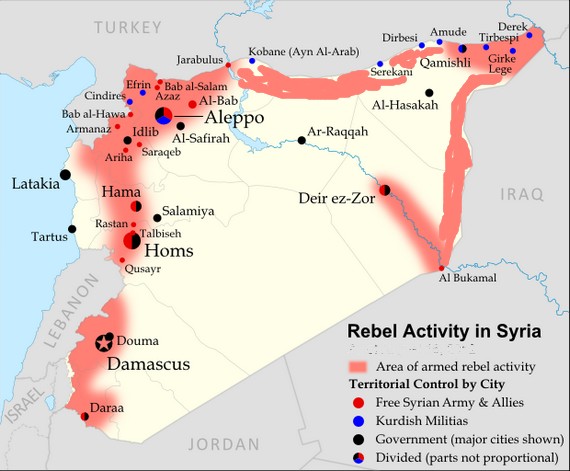
Yet, such a fracturing of Syria could, in the minds of some of the hard men around Assad, offer the prospect of salvaging more than they might if the regime is defeated and replaced by a strong, Sunni-dominated central state. Assad’s regime is not so much a personality-cult dictatorship as it is a system of Alawite minority rule and privilege, and its core remains a cohesive, heavily armed and highly motivated Alawite-dominated army that believes it is fighting for the survival of its community. Even once it recognizes that it can no longer rule the entire country, its sectarian communal logic may militate against making a desperate last stand in Damascus, a predominantly Sunni city.“Nobody knows what they’re thinking in the regime’s inner circles, but to the extent that the regime is making rational decisions, it doesn’t make much sense to take the ‘Samson option’ and use chemical weapons,” says University of Oklahoma Syria scholar Joshua Landis, referring to the Biblical figure who wanted to take down all with him as he died fighting. ”Unlike Gaddafi in Libya, Assad is ruling on behalf of a community, and the key decisions may not be his alone to make. The Alawite strongmen around him don’t want to commit suicide. They want to protect themselves and their families from the violent retribution they fear is inevitable if the regime falls.” That, argues Landis, may make them more likely to favor a retreat to the Alawite heartland along the coast, where they’ll have a greater base of strength than they do in Damascus. If so, the regime, as we know it, will have fallen, but the civil war would be far from over.If the Assad regime’s Alawite security core, which could field significantly more than 50,000 men motivated by fear for their lives, was to abandon Damascus, its best hope would lie in Syria breaking up into warring fiefdoms rather than reconstituting as a strong Sunni-dominated central government. The regime’s earlier strategic decision to cede control of Kurdish areas to a separatist militia with no intention of bowing to any authority in Damascus appears to reflect a preference for Balkanizing those parts of Syria it can no longer control. The regime will therefore also hope to see its enemies divided by the schism in rebel ranks between more extreme Salafist groups and those deemed secular or more moderately Islamist. Right now, the Syrian opposition coalition recently formed in Doha, Qatar, at Western behest may be recognized by France, Britain and Gulf states as the “sole legitimate representative of the Syrian people,” but its control over fighting units on the ground remains an aspiration rather than an established fact.Some of the most striking recent rebel victories in overrunning Assad’s bases have been chalked up by the Qaeda-inspired Jabhat al-Nusra militia, whose numbers are reportedly swelling to the point that its rivals estimate it fields up to 10,000 men, many of whom play the leading combat role on the fronts where they’re deployed.
Jabhat al-Nusra
The announcement by US officials that they are moving to proscribe Jabhat al-Nusra as a terrorist organization at this time is a bit confusing. It sends controdictory messages. Whose side is Washington on? Does it want to bring down Assad and support the rebels? Or does it want to start a civil war among the rebels? The latter would would be a boon to the Assad regime.
It sends a message to Qatar and Saudis: “don’t send money to Salafi groups or we will nail you for aiding terrorists and freeze any assets you have in the West.” It would also allow Congress to begin setting policy buy setting sanctions against any militia or regional authority that associates with Jabhat al-Nusra. The Treasury Department’s expanding anti-terrorism branch will also begin to set policy, as it must enforce this sanction.
Here is an NPR clip I did about this yesterday: Syrian Militia Leaders Depend On A Terrorist Faction – “Melissa Block talks with Joshua Landis about the ongoing conflict in Syria and whether the Bashar al-Assad regime has reached a tipping point.”
But it remains to be seen how a U.S.-authored move against the Nusra Front will be received by fighting units to whom the jihadists have become valuable partners in combat, while the U.S. is widely viewed by rebel fighters as having done little for their cause.Still, the Lebanese paper As-Safir reported Tuesday:Many expect a fierce battle to break out between the Salafists and the al-Nusra Front on one hand and the other armed groups on the other, under the pretext of uniting the [Free Syrian Army]… The FSA cannot unite without settling the Salafist and jihadist issue once and for all. That may happen if the West puts this as condition for sending arms, some believe.Civil wars, within civil wars, along the lines of those fought in Lebanon between 1976 and 1992 may be viewed as the best hope of survival by the hard men of the regime who turned Syria’s rebellion into a bloody sectarian war almost two years ago. That war has steadily dismembered the Syrian state; rebuilding it on new terms could take many turbulent years. At least, that’s what the more far-sighted in Assad’s circles may be hoping.
It’s Time to Recognize the Opposition in Syria – Room for Debate – New York times
“As Good as It’s Going to Get” by Joshua Landis, December 5, 2012
“As Good as It’s Going to Get” by Joshua Landis, December 5, 2012
Washington should recognize and support the newly formed National Coalition of Syrian Revolutionary and Opposition Forces. The United States has spent the last 21 months insisting on unity in what turns out to be a very fragmented Syrian opposition. This group is as good as it is going to get. It is filled with elite Syrians, who are educated, relatively pro-American, not too anti-Israel and not too Islamist — many of whom have gone to jail for their beliefs. This group will be able to retain popular backing from the West.The problem is that events on the ground in Syria have largely overtaken this effort at statecraft. Hundreds of militias are bringing down the Assad regime. They have largely driven the Syrian military out of the north and east of the country at a tremendous cost. They tend to look at the coalition as a foreign concoction, selected by unknown hands, and representing only itself.The Syrians fighting in the militias come from a very different background than those placed at the head of the coalition. They grew up in mostly rural areas and have only basic educations. Salafism is the ideology of the day, taking root with growing speed. Most come from the north of the country and the poorer towns outside of Aleppo, Idlib and Homs. Some have already rejected the coalition, others have said they will cooperate with it on the condition that it delivers money and arms soon, but none are likely to cede it real authority. The president and his two deputies all grew up in Damascus and hail from elite families. None have military experience.The big question that haunts the coalition is how it will gain control of the armed elements of the revolution. Today, Syria is ruled by guns, radicals and tough guys. It will take a miracle for the U.S. to glue this new exile leadership on top of the militia lords in Syria.

From Juan Cole – thanks Juan
The phone conversation above between two Alawite soldiers is very telling. They are caught in bases in the North that are about to fall to rebels, who presumable captured this recording and posted it to youtube. They are dispirited. Read this excellent article by Marlin Dick in the Daily Star about it.
…They both complain about the lack of support from other units, the inability to use many roads – “you just get blown up if you do” – and the isolation.Throughout the rest of the conversation they make several brief references to the state of the war and the regime’s prospects for victory. The caller talks about being a “strike force” in the area while the second man, who is markedly demoralized, rejects the idea, based on the steady, bloody attrition.“No … no … we’re not a strike force,” he insists, before asking: “What’s the point of being out here?”The caller tries repeatedly to boost his friend’s morale but at one point blurts out: “There’s no solution.”When the caller asks about defections, the demoralized officer’s response is: “No, there haven’t been any defections … there’s just … disgust.”Neither man presumes to predict how or when the war will end. Since it is the Eid, the caller asks his friend if sweets, baklava, were offered at the base to mark the holiday.“No, they didn’t bring me anything,” the demoralized officer responds immediately, before adding: “They brought me worries.”….As the caller laments a few times during the conversation, “There’s no one left from our graduating class.” مسرب مكالمة لضابطين من وادي الضيف وسراقب معنويات فوووق
Brookings: Al Qaeda 3.0: Terrorism’s Emergent New Power Bases |
2012-12-04
An American-Aleppine writes:
2012-12-04
An American-Aleppine writes:
From Free Syrian Army sources it seems that FSA surrounds the city of Aleppo in a circle with wide gaps. The circle stretches 3 to 10 miles outside the city limits. The Syrian Army controls inside this big circle except the south half of the city. There is a narrow no-mans land (about 5 percent of the city area) between the two halves of the city where most of the face-to-face fighting is taking place.
Under siege by drones in Pakistan and Yemen, al Qaeda 3.0 has exploited the Arab Awakening to create its largest safe havens and operational bases in more than a decade across the Arab world. This may prove to be the most deadly al Qaeda yet. The …
“Repression Is Not a Stupid Thing: The Syrian Regime’s Response to the Uprising,” by Reinoud Leenders (4 December 2012)
The ways in which the Syrian regime has been portrayed are reminiscent of the common tendency to view violence generally as deeply irrational, and – from ill-defined but morally unwavering liberal perspectives— as always counterproductive, destructive and self-defeating. Indeed, the more violence the Syrian regime resorted to, the more it came to be portrayed as inherently inadequate and senseless. In his questioning of the irrational qualities habitually attributed to armed conflict and violence generally, one scholar, Christopher Cramer (2006), gave his book the title “civil war is not a stupid thing”. Similarly, but with far more modest objectives, I present my argument that, during the uprising in Syria, authoritarian governance and repression has not been a ‘stupid thing’ either; on the contrary, and moral considerations and judgments set aside, the Syrian regime’s responses to the uprising suggest that it is ‘in-touch’, calculative, ‘rational’, and learning –if by trial and error, and surely without necessarily quelling the uprising. FULL TEXT AT
Bunker Mentality
2012-12-04 Telegraph View
2012-12-04 Telegraph View
Dec. 4 (Telegraph) — Even if President Bashar al-Assad remains rational, no one can be sure that he still controls Syria’s chemical arsenal, one of the largest in the world
With one miscalculation after another, President Bashar al-Assad has reduced Syria to a charnel house and his regime to a bloodstained gang with no aim save survival. Judging by their stark warnings, officials in Britain and America genuinely fear that he could crown his litany of crimes and misjudgments by unleashing Syria’s arsenal of chemical weapons….Mr Assad would be a latter-day Samson pulling down the pillars of
the temple
Free Syrian Army Fighters Destroy Statues of roman soldiers, calling themasnam, or idols.
The Internet – November 27, 2012
The Internet – November 27, 2012
For one Syrian activist, second thoughts on the armed rebellion
By David Enders | McClatchy Newspapers, December 03, 2012
HASAKA, Syria
By David Enders | McClatchy Newspapers, December 03, 2012
HASAKA, Syria
Hasaka is still controlled by the Syrian government, but even from the window of a taxi it’s obvious the people here have not been spared from the country’s civil war.The lines at bakeries are daylong, and many schools are closed because they’ve become homes for refugees from other parts of the country. The power is out now as often as it is on, and fuel is in ever shorter supply.Though she is happy to see him, Adam Ebrahem’s mother admonishes him for returning to his family’s home here.“You shouldn’t stay,” she says. “The PYD will kill you.”Ebrahem – it’s a pseudonym he uses for security reasons – is a 27-year-old revolutionary. A musician and a student, he was working and studying in Damascus when the rebellion against the government of President Bashar Assad began nearly two years ago. After months of demonstrating in Damascus, he returned to Hasaka to organize demonstrations. Now, as he travels across Hasaka province and in Deir al Zour province to the south, documenting the situation there, he openly wonders whether he and his fellow revolutionaries have done the right thing.“What will we tell our children? That we started this revolution and destroyed the country?”Ebrahem is a Kurd, the ethnic group that dominates Hasaka province and makes up about 10 percent of Syria’s population. The PYD is a Kurdish militia that is allied with the Syrian government; it’s the PYD that more or less controls the neighborhood Ebrahem’s family lives in. It also has clashed with anti-Assad rebels in northern Syria, heightening tensions between Kurds and Arabs.The first demonstrations, particularly in Damascus, were hopeful ones and deliberate in their displays of unity among the country’s sects and ethnicities. But as the violence grew, it was the Sunni Muslim Arab population that armed itself. Though the narrative that has persisted is that arming the rebellion was the only choice, many peaceful demonstrators like Ebrahem are tepid in their support of that decision, and some oppose it outright.Ebrahem’s family is making plans to leave Hasaka. They don’t expect it to remain free of widespread violence for much longer. No one does….But his forebodings were right. A few days later, Ebrahem gave an update by phone.“There was fighting between Kurdish and Arab students today at three schools in Hasaka,” he said.
The Confessions of a Sniper: A Rebel Gunman in Aleppo and His Conscience
By Rania Abouzeid / Aleppo
By Rania Abouzeid / Aleppo
He hails from a Sunni military family in a town on the outskirts of Damascus, the capital. His uncle is a serving general in President Bashar Assad’s army, several of his other relatives are also high-ranking military officers. Apart from his parents and siblings, his relatives all think he’s dead — and that’s the way he wants to keep it….He may look calm, but he’s deeply troubled. After some nine months of fighting with several Free Syrian Army units, first on the outskirts of Aleppo and then in the city itself after the rebel push into it in late July, he has grown disillusioned with the fight and angry with its conduct. “I did this when it was clean,” he says. “Now it’s dirty. Many aren’t fighting just to get rid of Bashar, they’re fighting to gain a reputation, to build up their name. I want it to go back to the way it was, when we were fighting for God and the people, not for some commander’s reputation.”He refused an order in November to fight a proregime, ethnic Kurdish militia in a Kurdish neighborhood of Aleppo that the rebels had entered. “Why should I fight the Kurds?” he says. “It’s a distraction. This isn’t our fight.”Syrians in the opposition, whether armed or not, have often said that there may be a revolution after the revolution to unseat Assad. The fault lines differ depending on whom you talk to. Some envision a fight between Islamist and secular rebels; others between defectors and armed civilians; some say it will be ethnic, between Kurds and Arabs; others simply territorial, between rebel commanders in a particular area, irrespective of ideology. Others say it won’t happen. The Sniper, like many fighting men, thinks that it will, and that it will be ugly: “We will not become Somalia after Bashar falls,” he says. “We will have many Somalias in every province.”…And so rebel snipers, especially professionally trained ones, are in great demand. The Sniper says he has “been offered so much money, it is as if I am working for the mafia.”“Some [rebel commanders] offered me money. Others would say, ‘Just tell me what you want.’ One told me, ‘I’ll bring your parents, take them to safety. Just come and work with me,’” he says. “It does not honor me to work with people like this who think they can buy and sell me.”Instead, he has found a home with Liwa Suqoor al-Sha‘ba, an Islamist unit of the Free Syrian Army headquartered in Azaz, a town north of Aleppo in the vast band of countryside in rebel hands around the city. For the past few months he has been stationed in the northeastern neighborhood of Bustan al-Basha, a devastated wasteland emptied of all but three of its thousands of residents. “We cannot charge on [government] positions — if we do, they will eliminate us — nor can they advance on us,” he says. “It’s not that I’m tired, but I want something new. New territory. I’m sick of it here, I’m disgusted by it.” But he respects his adversaries, who he says have pinned the rebels down now for months….“We were in school together. We grew up together. His mother was like my mother, that’s how close we were,” he says. The Sniper is pensive, takes several deep breaths and fidgets with his 10-mm handgun as he speaks of his friend, repeatedly flicking off the gun’s safety. The young men joined the army together and stayed in contact even after the Sniper defected. He was the only person outside of the Sniper’s immediate family who knew that he was still alive. “I would tell him to defect, he’d say, ‘Not yet, it’s still early.’ I’d say defect. I told him I’d come and get him, that I would go anywhere to see him, to help him defect, even to the gates of his brigade. Whatever he wanted, wherever he was, I would get him. He kept saying, ‘It’s still early, it’s early.’ He was scared that his family would go through the same thing my family went through.” The Sniper says his family members were interrogated, harassed, ostracized in their community. The only thing that saved them from greater harm, he suspects, was the clout of the loyalist military men in his family and the fact that they thought he was dead, not a defector.Mohammad was eventually sent to Azaz, stationed at what was called the Shatt Checkpoint. Both the Sniper and his commander repeatedly urged Mohammad to defect, warning him that they planned to attack the checkpoint. He didn’t listen. “We were three snipers. We killed a colonel, a soldier and my friend. I don’t know which one I killed, I didn’t see their faces. They were soldiers in front of us, and we were ordered to kill them.” That was three months ago.“He’s gone anyway, what good is thinking about it? I did — for a long time afterward. I thought, ‘Why? He was my friend. Why did I shoot at him? I shouldn’t have.’ But I have left those thoughts behind me. I have to move forward.”…“Whoever is going to be in my sights will die. That’s it,” the Sniper says. “My heart has hardened. I returned to religion, but after I killed, my heart hardened. A sniper sees who he kills,” he says, pausing. “It’s hard. A sniper sees his victim.”
Aleppo: How Syria Is Being Destroyed
The New York Review of Books 20/11/12
The New York Review of Books 20/11/12
New York Times
Mideast’s WMD ‘red line’ gauntlet
By Bennett Ramberg, December 3, 2012, Reuters
By Bennett Ramberg, December 3, 2012, Reuters
….Remember the ultimatums that called on Iraq to get out of Kuwait in 1991; the Taliban to surrender Osama Bin Laden in 2001, and the demand Saddam Hussein leave Iraq in 2003? Each failed and war ensued.With red line failure more often than not, both the United States and Israel must map a response. As it turns out, however, Washington may face the more immediate problem…..
Jihadists answer the call in Syria
USA TODAY -
USA TODAY -
______________-
Reminder: Read our article on the "chemical weapons". http://syriareport.net/chemical-weapons-evidence-comes-from-jabhat-al-nusra/

Syria Report
Read & Share Syria Report's important articles dealing with chemical weapons.
Back to Reality: Syria and Chemical Weapons: http://syriareport.net/syria-chemical-weapons/
Al-Qaeda's Chemical Weapons: http://syriareport.net/al-qaedas-chemical-weapons/
Chemical Weapons Found in Turkey Al-Qaeda Raid: http://syriareport.net/chemical-weapons-found-in-turkey-raid/
Iraq: Al-Qaeda Chemical Weapons Plot Uncovered: http://syriareport.net/iraq-al-qaeda-chemical-weapons-plot-uncovered/
Jabhat al-Nusra Behind “Chemical Weapons” Attacks?: http://syriareport.net/chemical-weapons-evidence-comes-from-jabhat-al-nusra/
oBOMBa caught lying again. It was oBOMBa's terrorist he is arming that used the chemical weapons yet again. That make 5 times now. I bet oBOMBa and his CIA stooges are giving it to them.
-----
New video footage has surfaced online showing the FSA militants (al-Qaeda, al-Nusra and friends) sponsored by Saudi and Qatar Wahhabi extremists in possession of chemical weapons. The video, which was posted on the internet recently, shows armed militants (unarmed civilians according to al-Jazeera and CNN) holding canisters containing chemical substances. The militants had earlier released footage in which rabbits were killed by inhaling poisonous gas.
It's not hard to guess the planned scenario of this modern day Goebbels's.
- First use this chemical weapons against civilians
- Then, put all the blame on the SAA
- And then, the final step, complain and cry over al-Jazeera and CNN propaganda machine about the humanitarian disaster caused by "the evil SAA"...
Read more at http://www.liveleak.com/view?i=5f6_1359454812#BwiliHjL0yfoiEb5.99

sábado, 15 de junio de 2013
بندر بن سلطان وسعود الفيصل في باريس: حربنا على حزب الله وايران في سوريا
| |
| نضال حمادة | |
 فرنسا لا تريد حلا للأزمة السورية كونها تشعر بتهميشها في حال حصل اتفاق بين روسيا وأمريكا حول الحرب في سوريا، وهذا الرفض الفرنسي او "يباس" الرأس الفرنسي كما وصفه موقع "آغورا" وضع كل العراقيل والعقبات أمام أي حل في سوريا، وبحث عن كل الحجج التي تجبر الإدارة الأمريكية على مراجعة سياستها التي تريد عدم إغضاب الروس كثيرا في سوريا. فرنسا لا تريد حلا للأزمة السورية كونها تشعر بتهميشها في حال حصل اتفاق بين روسيا وأمريكا حول الحرب في سوريا، وهذا الرفض الفرنسي او "يباس" الرأس الفرنسي كما وصفه موقع "آغورا" وضع كل العراقيل والعقبات أمام أي حل في سوريا، وبحث عن كل الحجج التي تجبر الإدارة الأمريكية على مراجعة سياستها التي تريد عدم إغضاب الروس كثيرا في سوريا.الموقف الفرنسي المتصلب وجد ضالته في المملكة العربية السعودية مع قطبي التصلب والعداء لسوريا متمثلا بوزير الخارجية سعود الفيصل وزوج أخته بندر بن سلطان بن عبد العزيز الذين زارا العاصمة الفرنسية باريس الأسبوع الماضي في زيارة خصصت لبحث كيفية العمل المشترك بين الطرفين السعودي والفرنسي لمحاربة حزب الله وإيران في سوريا، كما ذكر مرجع سوري معارض لموقع المنار. ويبدو ان الحاجة الفرنسية للمال ولبيع معدات عسكرية للخارج بعد الركود الذي تشهده مبيعات السلاح الفرنسي التقى مع حاجة السعودية لسند اوروبي قوي من اجل الاستمرار في سياسة الحرب في سوريا، ولا بأس أن تدفع مملكة النفط بعضا من الأموال لفرنسا لقاء خدمات تقدمها الأخيرة في الحرب على سوريا وعلى إيران وحزب الله في سوريا، وهذا التلاقي في المصالح جعل زيارة المسؤولين السعوديين لباريس حافلة بنقاط الاتفاق وخطط العمل التي سوف يتعاون الفرنسي والسعودي فيها على الاراضي السورية وفي أوروبا والخليج والعالم. وتذكر مصادر فرنسية مطلعة لموقع المنار نقاط الاتفاق السعودي الفرنسي كما يلي:
 ويبدو أن السعودية التي كانت تعول على تحالف تركي سعودي في مواجهة ايران تعيد حساباتها بعد صعود المد الإخواني في المنطقة بقيادة تركية واضحة، فضلا عن انتقال عدوى التظاهرات الى تركيا التي تستمر للأسبوع الثاني على التوالي، وهذا ما يثير مخاوف السعودية من انتقال العدوى اليها، لذلك وجه المسؤولون السعوديون وجههم يم فرنسا التي تتفق مع السعودية أيضا في الرغبة بإزاحة القطري من الواجهة، خصوصا أن باريس غاضبة من الدوحة بسبب صفقة دبابات كانت باريس تأمل من الدوحة ان تختار "دبابة لوكليرك" الفرنسية وقد اختار القطريون دبابة بريطانية، ما أثار غضب باريس التي سهلت لقطر استثمارات كبيرة في فرنسا وبعضها رمزي ومعنوي مثل نادي "باريس سان جيرمان" لكرة القدم او محلات "ميغاستور" على جادة الشانزيليزيه. ويبدو أن السعودية التي كانت تعول على تحالف تركي سعودي في مواجهة ايران تعيد حساباتها بعد صعود المد الإخواني في المنطقة بقيادة تركية واضحة، فضلا عن انتقال عدوى التظاهرات الى تركيا التي تستمر للأسبوع الثاني على التوالي، وهذا ما يثير مخاوف السعودية من انتقال العدوى اليها، لذلك وجه المسؤولون السعوديون وجههم يم فرنسا التي تتفق مع السعودية أيضا في الرغبة بإزاحة القطري من الواجهة، خصوصا أن باريس غاضبة من الدوحة بسبب صفقة دبابات كانت باريس تأمل من الدوحة ان تختار "دبابة لوكليرك" الفرنسية وقد اختار القطريون دبابة بريطانية، ما أثار غضب باريس التي سهلت لقطر استثمارات كبيرة في فرنسا وبعضها رمزي ومعنوي مثل نادي "باريس سان جيرمان" لكرة القدم او محلات "ميغاستور" على جادة الشانزيليزيه.ويقول معارض سوري أن الفرنسيين سوف يزودون المسلحين بأسلحة مضادة للدبابات واجهزة اتصال حديثة وصور أقمار صناعية لمواقع الجيش السوري في مناطق الاشتباك، بينما ستزود الولايات المتحدة المسلحين السوريين عبر مخازن أسلحة امريكية موجودة في الأردن وتشمل هذه المعدات "صواريخ حرارية مضادة للدروع، عربات نقل مصفحة، اجهزة اتصال مشفرة وموصولة عبر الاقمار الصناعية، مدافع هاون، ذخائر متنوعة"، فضلا عن عشرات الصواريخ التي سوف تستخدم في قصف مناطق لبنانية تتعرض للقصف حاليا من قبل المسلحين السوريين، وهذا ما جعل مصدر سوري معارض يتوقع صيفا سوريا ساخنا في ميدان المعركة...
موقع المنار غير مسؤول عن النص ومضمونه، وهو لا يعبّر إلا عن وجهة نظر كاتبه
http://www.almanar.com.lb/adetails.php?eid=512929&cid=51&fromval=1&frid=51&seccatid=161&s1=0 |
miércoles, 12 de junio de 2013
مدير الموساد يزور تركيا سريا ويبحث الملفين السوري والإيراني

زار مدير المخابرات الإسرائيلية (الموساد) تامر باردو تركيا بشكل سري وبحث مع وكيل المخابرات التركية هاكان فيدان في أنقرة الاثنين 10 يونيو/حزيران الملفين السورية والإيراني، حسب ما أفاد به موقع "Hurriet Daily News" الإخباري. كما طلب باردو من الجانب التركي تنظيم لقاء له مع رئيس الوزراء رجب طيب أردوغان، إلا أن الأخير لم يرد على الطلب، وفق "Hurriet Daily News". وتبادل باردو وفيدان معلومات حول آخر التطورات في سورية، ومدى تأثير إيران في الداخل السوري. وبحث الجانبان أيضا إمكانيات تبادل المعلومات المخابراتية بين البلدين، وذلك قبيل اجتماع "جنيف – 2" حول سورية المقرر في يوليو/تموز القادم وفي ضوء بعض التقارير عن تعاون الحرس الثوري الإيراني مع المخابرات السورية ضد تركيا، حسب "Hurriet Daily News". وتناول الجانبان موضوع الاحتجاجات الحالية في تركيا. هذا وقالت صحيفة "هآرتس" الإسرائيلية إن الجانب الإسرائيلي لم يؤكد لقاء باردو وفيدان في أنقرة، مشيرة إلى أن مدير "الموساد" ووكيل المخابرات التركية قد التقيا في مصر قبل عدة أشهر في سياق الجهود الدولية لتحقيق وقف إطلاق النار في قطاع غزة.
http://arabic.rt.com/news/618151/ :روسيا اليوم
lunes, 10 de junio de 2013
وقفة تضامنية وقداس إلهي لجاليتنا في أرمينيا وهنغاريا -فيديو
| |||
|


مصادر لصحيفة "ديلي تلغراف" البريطانية: أمير قطر سيترك السلطة قريبا http://arabic.rt.com/news/617894/ :روسيا اليوم

ذكرت صحيفة "ديلي تلغراف" أن قطر ستشهد قريبا عملية لانتقال السلطة من أمير البلاد الشيخ حمد بن خليفة آل ثاني لنجله الشيخ تميم بن حمد البالغ من العمر 33 عاما. وقال مسؤولون رفيعو المستوى في قطر "لشركائهم الأجانب" إن الوقت حان ليتولى ولي العهد السلطة في البلاد. وتنص خطة انتقال السلطة التي سيبدأ تنفيذها، حسب الصحيفة، في أواخر الشهر الجاري، على أن يترك حمد بن جاسم بن حمد آل ثاني منصب رئيس الوزراء. وأشارت "ديلي تلغراف" إلى أنه بعد أسابيع من هذا القرار، سيعلن الديوان الأميري أن الشيخ حمد بن خليفة الذي كان يعاني مشاكل صحية منذ فترة طويلة، سيسلم مقاليد السلطة إلى ولي العهد. بدورها، أشارت صحيفة "لوبوان" الفرنسية الى أن الشيخ حمد بن خليفة آل ثاني الذي يتولى الحكم منذ عام 1995، يرغب في الابتعاد عن السلطة. وحول مستقبل النهج السياسي لقطر، ذكرت "ديلي تلغراف" أن هناك تساؤلات بشأنه على الرغم من أن دبلوماسيين ومسؤولين في دول أخرى يعرفون الشيخ تميم جيدا. وأشارت "ديلي تلغراف" في هذا السياق الى علاقات وثيقة تربط ولي العهد الذي تلقى تعليمه في بريطانيا، بجيوش الدول الغربية. ونقلت الصحيفة عن محللين أن علاقة الشيخ تميم بالإخوان المسلمين قد تشير الى أنه لن يكون "زعيما ليبراليا" على غرار والده ورئيس وزرائه. وأعادت "ديلي تلغراف" إلى الأذهان أن الشيخ حمد تولى السلطة في انقلاب أبيض عام 1995، منتهزا فرصة غياب والده في رحلة الى أوروبا. أما نجله تميم(مواليد 1980)، وهو ابن الشيخة موزة الزوجة الثالثة لأمير قطر، فانه يتولى منصب ولي العهد منذ عام 2003. وقد تخرج تميم في أكاديمية "ساندهيرست" العسكرية الملكية في بريطانيا. ويشغل تميم حاليا منصب رئيس مجلس إدارة جهاز قطر للاستثمار ورئيس اللجنة الأولمبية القطرية.
http://arabic.rt.com/news/617894/ :روسيا اليوم
sábado, 8 de junio de 2013
Sama TV - وثائق تكشف حجم التآمر الغربي القطري السعودي الإسرائيلي على سورية
Syrian TruthRecords·

http://www.FB.ME/Syrian.Truth
http://twitter.com/Syrian_Truth
http://www.FB.ME/QOMHANE.SYRIA.Q.N.N
https://www.facebook.com/QNN.Media
https://www.facebook.com/Syria24.News
لضمان استمرارية العمل وعدم اغلاق القناة يرجى وضع لايك على مقطع الفيديو والاشتراك بالقناة
Syrian Truth in English:
http://www.FB.ME/syrian.truth.
jueves, 6 de junio de 2013
John Kerry Supports Al Qaeda in Syria, in Violation of US Anti-terrorism Laws


“The United States and its allies are not seeking a peaceful solution to the Syrian crisis.
If they were seeking a solution they would disengage in terms of their support to al-Nusra, which is a terrorist organization. Their actions are not only a violation of international law, they are also a violation of United States law, which classifies al-Nusra as a terrorist organization.”
Press TV has conducted an interview with Michel Chossudovsky, director of the Centre for Research on Globalization, Montreal, about Western-supported terrorist death squads against Syria, Also addressed in this interview is Russia’s delivery of the S-300 missile defense system to Syria to help deter foreign military intervention.
Press TV: Why does Germany and the US criticize Russia for sending arms to Syria while they themselves are providing weapons to Israel?
Chossudovsky: Well, it’s a nonsensical discourse of countries, which are in fact behind the terrorist organizations in Syria.
They cannot on the one hand be peacemakers in terms of the proposed Geneva peace conference and at the same time support an insurrection channeling weapons to al-Qaeda affiliated forces.
But there is another dimension.
They accuse Russia of providing weapons to Syria for defensive purposes under a bilateral agreement between two countries.
On the other hand we notice that the United States is channeling billions and billions of dollars to Israel.
Germany is on record of providing German-made submarines, which are tooled with Israeli nuclear warheads. In other words, in providing military technology in support of nuclear weapons, this is in violation not only of the Nuclear Non Proliferation Treaty, but also in violation of German and European laws.
Press TV: Why is it that only Israel’s security is so important and not the security of others in the region?
Chossudovsky: Well, this of course is an expression of double standards.
Syria is not a threat to countries in the Middle East. But if we look at Israel and we look at its history, it has waged wars against several neighboring countries, including Lebanon, Syria and Egypt, in the course of recent history.
And many of these operations have been in effect also been supported by US military aid.
Israel receives billions and billions and billions of dollars of US military aid.
And I should also mention that other countries in the region such as Qatar, Saudi Arabia, Turkey are also recipients of US military aid and much of this military aid is also being used to threaten Syria and to fund the insurrection, which is composed as we know of terrorist death squads.
Press TV: Despite the fact that the European Union has lifted an arms embargo on Syrian insurgents, how optimistic are you that the Geneva 2 talks will be able to resolve the Syrian crisis politically and not militarily?
Chossudovsky: The United States and its allies are not seeking a peaceful solution to the Syrian crisis.
If they were seeking a solution they would disengage in terms of their support to al-Nusra, which is a terrorist organization and its not only a violation of international law, but it’s also a violation of United States law, which classifies al-Nusra as a terrorist organization.
And it is somewhat ironic that US Secretary of State John Kerry is implementing a policy, which is in direct contradiction with the US anti-terrorist legislation – in fact he is in violation of those criteria because he is brokering a relationship with a terrorist organization and channeling US military aid to al-Qaeda.
Prof Michel Chossudovsky, globalresearch.ca
domingo, 2 de junio de 2013
Al-Qaeda militants form US neocons’ private army in Syria: Gordon Duff

Members of the terrorist group al-Nusra Front in Syria (file photo)
Sun Jun 2, 2013 9:39AM GMT
Syria has been gripped by a deadly unrest since March 2011, and many people, including large numbers of government forces, have been killed in the violence.
Related Interviews:
A prominent political analyst says US neo-conservatives are pursuing their objectives in Syria through their ‘private army’, which basically constitutes of al-Qaeda-linked militants fighting against the Damascus government, Press TV reports.
“Groups like the Mujahideen who fought during the Soviet War in Afghanistan, and later emerged as the Taliban and al-Qaeda were tools of the Central Intelligence Agency (CIA),” Gordon Duff, a senior editor at Veterans Today, told Press TV by phone on Saturday.
“There never was an al-Qaeda; well there is today. A very real al-Qaeda has been assembled, and it’s in Syria now,” he stated.
Duff added that there were pictures of “aircraft leased to the Department of Defense” on which the CIA was flying al-Qaeda members into Syria to take control of Syrian villages.
“They are taking women and girls hostage and using them as tools of sexual battery,” Duff said.
He also condemned US Senator John McCain’s surprise visit to Syria earlier this week, during which the Arizona senator met with a group of foreign-sponsored militants.
“Photographs have him meeting with criminal elements and with al-Qaeda commanders.”
Syria has been gripped by a deadly unrest since March 2011, and many people, including large numbers of government forces, have been killed in the violence.
Damascus says the chaos in the country is being orchestrated from outside.
Syrian President Bashar al-Assad has said that if the militants take power in Syria, they could destabilize the entire Middle East region for decades.
MP/HSN


_____________________-
McCainVisitedKidnappersinSyria
A shocking report from pan-Arab TV station Al-Jadeed reveals America’s Republican Senator, John McCain, visited kidnappers of Lebanese pilgrims.
Elizabeth O’Bagy, political director for the “Syrian Emergency Task Force” and , a U.S.-based nonprofit providing support to the opposition, allegedly organised the visit which brought McCain just half a mile inside Syria on Monday 27 May.
The 76 year-old notoriously hawkish senator is particularly famous for singing a song consisting of the words “bomb, bomb, bomb Iran.”
In one meeting inside the Syrian border at the Bab al-Salameh border border crossing, he held talks with Asifat al-Shamal (Northern Storm Brigade), which controls the crossing. Asifat al-Shamal is one of countless militant groups which make up the much reported “Free Syrian Army”, a term which has becoming increasingly redundant as sectarianism, religious extremism and Al-Qaeda ideology become the norm.
In Elizabeth O’Bagy’s own Twitter commentary, she announced that McCain was hosted by the Asifat al-Shamal Brigade and met twenty “commanders” in total.

Soon after or during the snap visit, at least three photos surfaced showing McCain posing with various individuals.
In the following images, McCain is posing with senior members of the Asifat al-Shamal Brigade as well as the chief of the “Free Syrian Army”, Salim Idriss.
On May 22, 2012, dozens of Lebanese men and women were travelling on a bus through Syria on their way back to Lebanon from a pilgrimage to religious sites in Iran. After crossing the Turkish border into the Aleppo region, the bus was ambushed in Azzaz by around 30 gunmen, who forced several of the passengers to dismount at gunpoint. The militants instructed one of the passengers to go to the local police station, report the ambush and inform police officers of a desire to swap the hostages for two individuals being held by police.
Following much global media coverage, it was alleged by supporters and apologists of armed groups that the hostages were “members of Hezbollah”, a predictable accusation, echoing countless war crimes in which the victims are accused of being somehow linked to the Syrian government. Usually, the victims are of a minority sect, underlining the overt sectarianism espoused by the thousand or so militant groups operating in Syria. Victims of the ambush say that they were never accused of being members of Hezbollah, but rather, that because they are Shia Muslims, they could be used as leverage to negotiate with the Syrian government. The same militant group, kidnapped Lebanese journalist Fidaa Itani in late 2012.
In total, eleven men were kidnapped by the militant groups in Azzaz. The hostages have been regularly referred to as “the Forgotten” as they are still being held in captivity.
Daniel Shoueib, a relative of one of the hostages, who was reading the news of McCain’s surprise and unexpected visit, was shocked to see the photo which showed men he recognised as the kidnappers on May 22, 2012. Daniel went on to criticise American policy, specifically the sponsoring and support of terror groups who are responsible for acts such as sectarian kidnappings. .. points to the sign in the larger version of the photo which among other words printed, says “New Syria”.
Another relative, Hayat Aouali, spoke of the United States with its influence over armed militant groups, challenging its decision-makers to use the influence to bring about the release of the hostages, who are said to be held in circumstances involving maltreatment.
Significantly, Turkey’s support for armed groups in Syria, especially for the organisation with which McCain visited in Syria, paints a bleak picture of regional positions toward Syria. Indeed, it appears to vindicate the Syrian government’s position that the insurgency and violence are a result of foreign intervention.
Reporters from Lebanon’s Al-Jadeed TV met militants from the Asifat al-Shamal Brigade at the Bab al-Salameh border crossing, as did John McCain on Monday. In a screenshot of Al-Jadeed TV’s report, a man identified as Muahmmad Noor can be seen – a member of the militant brigade.

In the images of McCain’s visit, the same man can be seen.

The man behind McCain’s right shoulder is Abu Youssef. He stamped the passports of the Al-Jadeed TV staff when they visited Syria through the Bab al-Salameh border crossing. The following images show Abu Youssef in both a screenshot from the Al-Jadeed report and him posing with McCain during his visit.


Abu Youssef to McCain’s behind-right

Mohammad Noor & Abu Youssef

The following is the report from Al-Jadeed TV. The clip was translated by Arabi Souri.
Abu Youssef is spotted in a CNN report on McCain’s visit. Note that the man being interviewed is present in all of the photos of the senators visit – highlighting the mainstream media’s reliance on what it usually refers to as peaceful “activists”, despite there oftentimes active involvement in armed and usually sectarian militant organisations.

Screenshot of CNN report shows Abu Youssef with McCain during a meeting
Thanks to Arabi Souri and Mustafa who helped with the translation of material.
Thanks also to Luke for editing.
SOURCE: http://syriareport.net/mccain-visited-kidnappers-in-syria/
jueves, 30 de mayo de 2013
McCain visit to Syria: Terrorists meeting Terrorists !
![Foto: "The Daily Beast’s Josh Rogin reports that Senator John McCain ventured into Syria recently to visit with rebel fighters, taking a detour from his official trip to Turkey (where he also met with anti-Assad rebels). McCain was accompanied on his tour by General Salim Idriss, a defector from Assad’s army who has won fans in the West by rejecting the most extreme and jihadist elements of the opposition, including the Nusrah Front, which is essentially a branch of al-Qaeda in Iraq, and otherwise appearing like a man McCain and others can do business with.
The (East) German-educated soldier and engineer, unfortunately, appears to have very little influence or credibility among the rebels — McCain, presumably, would like to try to change that with an influx of American aid for the good general.
Senator McCain, one of the cheerleaders of the U.S./NATO intervention in Libya (where he also met with rebels) has been calling for more U.S. intervention in Syria for a long time now, and he’s a strident supporter of shipping arms to the opposition. The European Union could be on the verge of making that leap — ahead of a meeting of the union’s foreign ministers this week, Britain and France announced that they would support lifting the current embargo on weapons transfers to Syria."
http://tinyurl.com/pmjruzj
"In Syria, there is mounting evidence that Al Qaeda and its allies are actively deploying terror tactics and suicide bombers to overthrow the Assad regime.
Syrian citizens who prefer the secular and stable state to the prospect of an Iraqi-style sectarian state may well be turning this same question around to the US government: are you with us, or with the terrorists?
This week, head of the Salafi jihad and close ally of al Qaeda, Abu Sayyaf, pledged ''deadly attacks'' against Syria as ''our fighters are coming to get you'' because ''crimes'' by the regime ''prompts us to jihad''.
Bush referred to al Qaeda as the enemies of freedom: ''the terrorists' directive commands them to kill Christians and Jews''. But Sheikh Muhammad al Zughbey proclaimed that ''your jihad against this infidel criminal and his people is a religious duty … Alawites are more infidel than the Jews and Christians''. Because the new jihad targets Alawites rather than Jews and Christians, does this render them better bed fellows?
By his own admission, Bush stated that al Qaeda was ''linked to many other organisations in different countries … They are recruited from their own nations … where they are trained in the tactics of terror … They are sent back to their homes or sent to hide in countries around the world to plot evil and destruction''.
Yet this is precisely how the foreign jihadists in Syria have been described by reporters. They are funded and armed by Saudi Arabia and Qatar. And they collaborate with the Free Syrian Army which is aided and abetted by the US."
http://tinyurl.com/8gmjpt2
"President Obama will have no talk of peace. He has chosen war since the very start and he’s sticking to it. A recent New York Times article revealed that President Obama has been lying through his teeth about the level of U.S. involvement in the Syrian conflict since the beginning.
The President recently said that the U.S. government continues to give only “non-lethal” military aid to the rebels, but The New York Times revealed that the CIA has been actively funneling and distributing massive shipments of weapons to the rebels over the borders of Jordan and Turkey.
This “arms pipeline” of illegal gun trafficking has been overseen by the U.S. government since January 2012. It has literally been the lifeblood of the Syrian “rebels,” and thus the cause of the immense bloodshed in Syria.
The New York Times reports:
“The C.I.A. role in facilitating the [weapons] shipments… gave the United States a degree of influence over the process [of weapon distribution]…American officials have confirmed that senior White House officials were regularly briefed on the [weapons] shipments.”
The article also explains that a “conservative estimate” of the weapons shipment to date is “3,500 tons.”
So while Obama has repeatedly lied about “non-lethal” military aid, he has been personally involved in overseeing a multi-country flood of weapons into Syria, many of which are given to terrorist organizations. The only effective fighting force for the Syrian rebels has been the terrorist grouping the Al Nusra Front, and now we know exactly where they got their guns.
If not for this U.S.-sponsored flood of guns, the Syrian rebels — many of them from Saudi Arabia and other countries — would have been militarily defeated long ago. Tens of thousands of lives would thus have been spared and a million refugees could have remained in their homes in Syria. The large scale ethnic-religious cleansing initiated by the rebels would have been preventable.
But Obama is so intent on war that he will not even discuss peace with the Syrian government. He has repeatedly stated that there are “preconditions” for peace negotiations, the most important one being the downfall of the Syrian government, i.e., regime change. If a toppling of a nation’s government is Obama’s precondition for peace, then Obama is by definition choosing war.
Never mind that Syria is a sovereign nation that should not have to worry about a foreign country making demands as to who is in power. Obama doesn’t seem to think this relevant. In fact, his administration has been very busy determining who the “legitimate” government of Syria is, by hand picking the “National Coalition of Syrian Revolution,” the prime minister of which is a U.S. citizen.
One of the preconditions for being on Obama’s National Coalition of Syrian Revolution is that there be no peace negotiations with the Syrian government. Of course most Syrians want to immediately end the conflict in Syria, since it threatens an Iraq-like destruction of the country.
The most popular leader of the National Coalition of Syrian Revolution, Moaz al-Khatib, recently quit in protest because he was prohibited from pursuing peace negotiations by the U.S.-appointed opposition Prime Minister, Ghassan Hitto, a U.S. citizen who had lived in the U.S. for the previous 30 years."
"Obama also recently pressured the Arab League — composed of regimes loyal to the United States — to install as a member the hand-picked National Coalition of Syrian Revolution as the official government of Syria. The appointment didn’t give as much credibility to the opposition as much as it degraded the Arab League’s legitimacy.
The rebel’s seat in the Arab league implies, again, that the U.S. and its allies are fully intent on “regime change,” no matter how many people die, no matter the existing political alternatives. They will not reverse course.
The Russian government called the Arab League membership decision “… an open encouragement of the [rebel] forces which, unfortunately, continue to bet on a military solution in Syria, not looking at multiplying day by day the pain and suffering of the Syrians…. Moscow is convinced that only a political settlement and not encouraging destructive military scenarios, can stop the bloodshed and bring peace and security to all Syrians in their country.”
Obama has rejected both Russian and Syrian calls for peace negotiations in recent months, as he has greatly increased the frequency of the weapons trafficking plan."
http://tinyurl.com/d5h35ue
"Confrontation with Iran has been the goal of U.S. foreign policy for decades and Syria is one more strategic stepping stone in the process. Syria is one of Iran's strongest allies in the region and getting rid of Assad will further isolate Iran.
While visiting Iran in 2010, Assad said: "We have stood beside Iran in a brotherly way from the very beginning of the (Iranian Islamic) revolution."
During the visit, Iranian President Mahmoud Ahmadinejad awarded Assad Iran's highest medal of honor in recognition of his support for Palestinians and Lebanon and his resistance to "global arrogance" -- a term which usually refers to the United States and its allies.
Assad also rejected an offer by the U.S. to have sanctions dropped against his country if Syria ditched Iran as an ally."
"In 2008, Syria agreed to allow Russian missile defense systems into their country as a counterweight to plans for a United States missile deployment to Poland.
That same year, according to UPI: "Syria is adding the latest Russian MiG-29SMT fighter to 36 Pantsir S1E air-defense systems purchased from Russia, RIA Novosti reported, noting Syria also hopes to buy Strelets short-range air defense systems, Iskander tactical missile systems, Yak-130 aircraft and two Amur-1650 submarines -- all Russian-made."
In terms of the China-Syria relationship: "China has become Syria’s number one supplier. While figures from Syria’s Bureau of Statistics put the value of Syrian imports from China at $691 million, Syrian officials have said the real figure is more likely to be close to double that at around $1.2 billion. What is not in doubt is that China easily outstrips Syria’s other major suppliers Egypt ($553 million), South Korea ($441 million), Italy ($356 million), Turkey ($338 million), Japan ($317 million) and Germany ($308 million). Bilateral trade surged to a record high of $1.4 billion in 2006. [...] China was the second largest non-Arab investor in Syria in 2006, accounting for $100 million out of the $800 million in non-Arab investment funds which flowed into the country. By the end of 2006, Chinese companies had signed project contracts worth $819 million and this amount is virtually guaranteed to be superseded this year with a billion dollar oil refinery deal near completion.""
"Former Iraqi leader Saddam Hussein ditched the dollar back in 2000.
Former Libyan leader Muammar Gaddafi talked about dropping the dollar in 2009.
During the same year, Iranian leader Muammar Ahmadinejad switched Iran's reserve currency off the dollar.
In 2006, as reported by the Chicago Tribune, Syria "switched the primary hard currency it uses for foreign goods and services from the U.S. dollar to the euro in a bid to make it less vulnerable to pressure from Washington.""
http://tinyurl.com/b4qject](https://fbcdn-sphotos-a-a.akamaihd.net/hphotos-ak-prn2/p480x480/983719_554977867879250_809632686_n.jpg)
foto de Syrian Rationalism.
"The Daily Beast’s Josh Rogin reports that Senator John McCain ventured into Syria recently to visit with rebel fighters, taking a detour from his official trip to Turkey (where he also met with anti-Assad rebels). McCain was accompanied on his tour by General Salim Idriss, a defector from Assad’s army who has won fans in the West by rejecting the most extreme and jihadist elements of the opposition, including the Nusrah Front, which is essentially a branch of al-Qaeda in Iraq, and otherwise appearing like a man McCain and others can do business with.
The (East) German-educated soldier and engineer, unfortunately, appears to have very little influence or credibility among the rebels — McCain, presumably, would like to try to change that with an influx of American aid for the good general.
Senator McCain, one of the cheerleaders of the U.S./NATO intervention in Libya (where he also met with rebels) has been calling for more U.S. intervention in Syria for a long time now, and he’s a strident supporter of shipping arms to the opposition. The European Union could be on the verge of making that leap — ahead of a meeting of the union’s foreign ministers this week, Britain and France announced that they would support lifting the current embargo on weapons transfers to Syria."
http://tinyurl.com/pmjruzj
"In Syria, there is mounting evidence that Al Qaeda and its allies are actively deploying terror tactics and suicide bombers to overthrow the Assad regime.
Syrian citizens who prefer the secular and stable state to the prospect of an Iraqi-style sectarian state may well be turning this same question around to the US government: are you with us, or with the terrorists?
This week, head of the Salafi jihad and close ally of al Qaeda, Abu Sayyaf, pledged ''deadly attacks'' against Syria as ''our fighters are coming to get you'' because ''crimes'' by the regime ''prompts us to jihad''.
Bush referred to al Qaeda as the enemies of freedom: ''the terrorists' directive commands them to kill Christians and Jews''. But Sheikh Muhammad al Zughbey proclaimed that ''your jihad against this infidel criminal and his people is a religious duty … Alawites are more infidel than the Jews and Christians''. Because the new jihad targets Alawites rather than Jews and Christians, does this render them better bed fellows?
By his own admission, Bush stated that al Qaeda was ''linked to many other organisations in different countries … They are recruited from their own nations … where they are trained in the tactics of terror … They are sent back to their homes or sent to hide in countries around the world to plot evil and destruction''.
Yet this is precisely how the foreign jihadists in Syria have been described by reporters. They are funded and armed by Saudi Arabia and Qatar. And they collaborate with the Free Syrian Army which is aided and abetted by the US."
http://tinyurl.com/8gmjpt2
"President Obama will have no talk of peace. He has chosen war since the very start and he’s sticking to it. A recent New York Times article revealed that President Obama has been lying through his teeth about the level of U.S. involvement in the Syrian conflict since the beginning.
The President recently said that the U.S. government continues to give only “non-lethal” military aid to the rebels, but The New York Times revealed that the CIA has been actively funneling and distributing massive shipments of weapons to the rebels over the borders of Jordan and Turkey.
This “arms pipeline” of illegal gun trafficking has been overseen by the U.S. government since January 2012. It has literally been the lifeblood of the Syrian “rebels,” and thus the cause of the immense bloodshed in Syria.
The New York Times reports:
“The C.I.A. role in facilitating the [weapons] shipments… gave the United States a degree of influence over the process [of weapon distribution]…American officials have confirmed that senior White House officials were regularly briefed on the [weapons] shipments.”
The article also explains that a “conservative estimate” of the weapons shipment to date is “3,500 tons.”
So while Obama has repeatedly lied about “non-lethal” military aid, he has been personally involved in overseeing a multi-country flood of weapons into Syria, many of which are given to terrorist organizations. The only effective fighting force for the Syrian rebels has been the terrorist grouping the Al Nusra Front, and now we know exactly where they got their guns.
If not for this U.S.-sponsored flood of guns, the Syrian rebels — many of them from Saudi Arabia and other countries — would have been militarily defeated long ago. Tens of thousands of lives would thus have been spared and a million refugees could have remained in their homes in Syria. The large scale ethnic-religious cleansing initiated by the rebels would have been preventable.
But Obama is so intent on war that he will not even discuss peace with the Syrian government. He has repeatedly stated that there are “preconditions” for peace negotiations, the most important one being the downfall of the Syrian government, i.e., regime change. If a toppling of a nation’s government is Obama’s precondition for peace, then Obama is by definition choosing war.
Never mind that Syria is a sovereign nation that should not have to worry about a foreign country making demands as to who is in power. Obama doesn’t seem to think this relevant. In fact, his administration has been very busy determining who the “legitimate” government of Syria is, by hand picking the “National Coalition of Syrian Revolution,” the prime minister of which is a U.S. citizen.
One of the preconditions for being on Obama’s National Coalition of Syrian Revolution is that there be no peace negotiations with the Syrian government. Of course most Syrians want to immediately end the conflict in Syria, since it threatens an Iraq-like destruction of the country.
The most popular leader of the National Coalition of Syrian Revolution, Moaz al-Khatib, recently quit in protest because he was prohibited from pursuing peace negotiations by the U.S.-appointed opposition Prime Minister, Ghassan Hitto, a U.S. citizen who had lived in the U.S. for the previous 30 years."
"Obama also recently pressured the Arab League — composed of regimes loyal to the United States — to install as a member the hand-picked National Coalition of Syrian Revolution as the official government of Syria. The appointment didn’t give as much credibility to the opposition as much as it degraded the Arab League’s legitimacy.
The rebel’s seat in the Arab league implies, again, that the U.S. and its allies are fully intent on “regime change,” no matter how many people die, no matter the existing political alternatives. They will not reverse course.
The Russian government called the Arab League membership decision “… an open encouragement of the [rebel] forces which, unfortunately, continue to bet on a military solution in Syria, not looking at multiplying day by day the pain and suffering of the Syrians…. Moscow is convinced that only a political settlement and not encouraging destructive military scenarios, can stop the bloodshed and bring peace and security to all Syrians in their country.”
Obama has rejected both Russian and Syrian calls for peace negotiations in recent months, as he has greatly increased the frequency of the weapons trafficking plan."
http://tinyurl.com/d5h35ue
"Confrontation with Iran has been the goal of U.S. foreign policy for decades and Syria is one more strategic stepping stone in the process. Syria is one of Iran's strongest allies in the region and getting rid of Assad will further isolate Iran.
While visiting Iran in 2010, Assad said: "We have stood beside Iran in a brotherly way from the very beginning of the (Iranian Islamic) revolution."
During the visit, Iranian President Mahmoud Ahmadinejad awarded Assad Iran's highest medal of honor in recognition of his support for Palestinians and Lebanon and his resistance to "global arrogance" -- a term which usually refers to the United States and its allies.
Assad also rejected an offer by the U.S. to have sanctions dropped against his country if Syria ditched Iran as an ally."
"In 2008, Syria agreed to allow Russian missile defense systems into their country as a counterweight to plans for a United States missile deployment to Poland.
That same year, according to UPI: "Syria is adding the latest Russian MiG-29SMT fighter to 36 Pantsir S1E air-defense systems purchased from Russia, RIA Novosti reported, noting Syria also hopes to buy Strelets short-range air defense systems, Iskander tactical missile systems, Yak-130 aircraft and two Amur-1650 submarines -- all Russian-made."
In terms of the China-Syria relationship: "China has become Syria’s number one supplier. While figures from Syria’s Bureau of Statistics put the value of Syrian imports from China at $691 million, Syrian officials have said the real figure is more likely to be close to double that at around $1.2 billion. What is not in doubt is that China easily outstrips Syria’s other major suppliers Egypt ($553 million), South Korea ($441 million), Italy ($356 million), Turkey ($338 million), Japan ($317 million) and Germany ($308 million). Bilateral trade surged to a record high of $1.4 billion in 2006. [...] China was the second largest non-Arab investor in Syria in 2006, accounting for $100 million out of the $800 million in non-Arab investment funds which flowed into the country. By the end of 2006, Chinese companies had signed project contracts worth $819 million and this amount is virtually guaranteed to be superseded this year with a billion dollar oil refinery deal near completion.""
"Former Iraqi leader Saddam Hussein ditched the dollar back in 2000.
Former Libyan leader Muammar Gaddafi talked about dropping the dollar in 2009.
During the same year, Iranian leader Muammar Ahmadinejad switched Iran's reserve currency off the dollar.
In 2006, as reported by the Chicago Tribune, Syria "switched the primary hard currency it uses for foreign goods and services from the U.S. dollar to the euro in a bid to make it less vulnerable to pressure from Washington.""
http://tinyurl.com/b4qject
https://www.facebook.com/Iran.Military
Suscribirse a:
Entradas (Atom)
